Tuesday, November 22, 2011

Making Magic.

Last week, I picked up a novel called The Magicians by Lev Grossman, thinking that this might be a fun read for our girlie. As I found it in the teen section, however, I decided to read it first. (Confession: I love kids books, teen books, ANY books.) 

Whew. Thank goodness I checked it out! Within the first two pages, the author introduced topics including virginity (or lack thereof), masturbation, as well as some... flavorful... language.

Now, I'm not a book burner. In fact, nothing incites me more than extremist groups who try to ban Harry Potter from school libraries. But, I do worry about age appropriateness, particularly when a 10-year-old reads books with teen protagonists.

Yep. Not passing along this book to my daughter just yet.

Don't get me wrong—it's a good read so far. It's just too mature for my Kiki. Although she loves books with magic and fantasy, this one has a bit too much harsh reality that I don't want her to experience ever too soon.

Still, there is something magical about pushing the limits. As a child, I definitely read books that were too advanced for my age. And boy, do I remember the trouble we got in for passing around my friend Diane's dog-eared copy of Forever. I wasn't typically a rule breaker, but on the few occasions that I did—it was, well, thrilling.

And empowering.

Maybe even a little magical.

Breaking the rules and pushing limits is still a bit of a rush—but now, my rebelliousness lives in the garden.

(Wow, writing that aged me about 20 years, didn't it?)

I admit—I am very behind on my gardening chores this fall. In fact, I just planted our fall vegetable garden—two weeks ago. Even by South Carolina, zone 7b standards...that's late. It's almost futile.

Unless you push the limits and disobey certain rules.

Recently, I've become enamored with the concept of season extension. What can I do, with our little piece of earth, to feed my family throughout the winter? How can I keep my fall garden producing? Can I fight the elements and extend the harvest, even if the “experts” disagree? Will my garlic crop fail if I don't get it planted by Halloween? Will my lettuce wither and melt if I plant it in late October instead of mid-September? Or can I thumb my nose at conventional gardening wisdom and produce a bumper crop of brassicas to harvest in January?

The key, I think, is to break some of the rules...but still adhere to some of the tried and true methods for season extension.

There's a really terrific program with which I'm lucky enough to be associated: Greenville Organic FoodsOrganization's (GOFO) Grow Healthy Kids. Through GOFO, schools in a local district can participate in growing an edible garden, complete with lessons that match the ever important state curriculum standards. The students receive transplants and seeds, as well as organic fertilizer and supplies, from GOFO. However, the key to the success of the gardens is the highly technical row covers GOFO provides, which allows the schools to protect their crops during cold periods, so that the kids can continue to harvest crops throughout the semester.

Plastic covering + bent metal masonry ladders = mini greenhouses.

The schools can participate in both the spring and fall, with the focus on cool weather crops, since those are the veggies most easily grown during the school year in Upstate South Carolina. The low tunnels are easy to install, and the supports can remain in place throughout the growing season. When a freeze watch is issued, the teacher or students can simply place the plastic over the supports, securing the covering to the ground with rocks or bricks to keep it in place. The plastic protects the plants from damaging frost and insulates the plants from severe temperatures. On average, the temperature in the low tunnel is approximately 10 degrees warmer than the outside air. In our zone, those 10 degrees can mean the difference between an ongoing harvest—and complete crop loss.

Because I'm the Master Gardener liaison for the Grow Healthy Kids program, I decided it's time to practice what I preach.

Typically, I plant our fall garden in the potager—my experiment in an attempt to design a formal, attractive kitchen garden. Honestly, our other gardens are—to put it nicely—wild. Unkempt. In serious need of hours of weeding and prettifying. The potager is my one place that I try to keep balanced and organized. 


It's also the perfect experiment for bending the rules with season extension.

Because the potager resides in the midst of our backyard, and because our two sweet pups are fabulous destroyers of all things green, my darling husband installed a fence around the potager when we designed it.

My supports are already in place!

With no need to buy additional hardware to make low tunnel supports, I headed to the big orange box store to purchase the plastic cover. I spent a little bit more for a thicker covering. Wow--who knew how many assorted plastic drop cloths are available? For $25, I found a 4 mm, 20' x 50' plastic sheet to serve as the insulation of the low tunnel.

Honestly, the trickiest part of installing my winter covering was unrolling the plastic—if you have a friend handy, recruit the extra pair of hands. Still, in less than 15 minutes, the potager was covered, the plastic was secured to the ground on each side of the fence with several rocks, and the cool weather crops were insulated against the nighttime low of 30 degrees. 


Now, that's cold for South Carolina!

While the plastic protects against the freezing temperatures, it can also damage the garden if the temperature spikes. Immediately following our few days of freezing nights, we're back in the 70s this week. 

The beauty of the low tunnel system is its simplicity—when it's warm, roll the cover off the frame and leave it on the ground (or, in my case, on one side of the fence...)


and when the temperature drops—pull the cover back over the frame.

Presto! Fresh veggies into the winter!

It's like magic! (I hope.)

So, because I planted the fall garden so recently, I haven't harvested anything from it yet. Soon, I hope we'll have lettuce (eight heirloom varieties), spinach, chard, broccoli, pac choi, red cabbage, and cauliflower. 


But, because of the “Produce Post” hosted by smallkitchengarden.net, I thought I'd share a few things we're enjoying this week from the garden:


The fraise des bois keep surprising me. Even after several frosts, they are still producing fruit—and more flowers! Love, love these tiny delicious garden gems.

Last night, along with the quiche made from the eggs provided by our backyard chickens and enhanced with chives from the garden...


...we ate one of the last tomatoes of the season...picked green and ripened in a paper bag with a banana. Ripening green tomatoes was a huge success—our freezer is now filled with bags of tomatoes to use this winter, all picked while still green.

Our nine varieties of garlic harvested this summer continue to be a staple ingredient in almost every dish we cook. How can anyone not like garlic—especially homegrown garlic?

Probably the single most prevalent item I'll be using from the garden this week will be herbs...lots and lots of sage, parsley, rosemary, and thyme for Thanksgiving dinner. Our local, organic turkey will be dressed with many herbs. I'm still harvesting:

 Provence lavender


Italian Flat Leaf Parsley


 Pineapple Mint

 Peppermint

 Tri-Color Sage

Curly Parsley

Chives

 Greek Oregano

 Lemon Thyme

 Rosemary, possibly my favorite of all herbs.

So, while we won't be eating from the potager just yet, we might be harvesting heirloom lettuce to serve at Christmas dinner.

Homegrown lettuce in December? It's kind of...magical, don't you think?

Happy gardening!

XO ~

Julie

Tuesday, November 15, 2011

November Roses. And Tasty Treats.

Next year, during the oppressive heat and humidity that epitomizes South Carolina's summer, I need to remember this week.

This is why I love South Carolina.


Gorgeous foliage...


...while pots of fraise des bois still bloom and produce fruit—even after a slight frost.


Is there anything better than the ultra-sweet taste of these tiny, unexpected berries?


Truly, although I'm late planting our fall crops in the potager, I know that the lettuce and greens will provide tasty meals throughout the winter with just a little attention and protection.


And finally, my long neglected roses...

My poor roses that were breathtaking in the spring, succumbed to Japanese beetles, heat, and my apathy during the summer...


...generously producing one last bouquet, their fragrance competing with the autumn spices of cinnamon, nutmeg, and apples baking.

But, I fear, most of the remaining blooms will be gone before the next Garden Blogger Bloom Day.

Ah, but there are always pansies. And paperwhites! And amaryllis! And spring, in just a few months...sigh.

Happy Garden Bloggers' Bloom Day! Thank you to May Dreams Gardens for hosting!

XO ~

Julie

Gluttony for Good.


'Tis the season to eat. Heartily. Locally. Gluttonously. Thank goodness, it's finally sweater weather, because the amazing dinners in which we've been indulging are seriously taking a toll on my waistline—and the holiday eating is just around the corner. I'm hoping a few layers of wool might hide the results of my recent and soon-to-be overindulgences.


My ever-increasing jean size is for a good cause, though. Really. I'm just trying to show my support for local farmers--lending some encouragement, helping ensure the local food scene thrives.


It's a tough job.


Our most recent outing involved an amazing organization, seven brilliant chefs, a dozen local food producers, and a stunning farm—all combining talents to showcase the deliciousness of Upstate South Carolina.


Saturday evening, Peter and I attended the second annual Hub City Farmers' Market Farm Dinner at Live Oak Farms. Live Oak Farms is one of my favorite local farms. Operated by Allison and Chuck Schaum, 80-acre Live Oak Farms not only epitomizes sustainability through the Schaum's commitment to raising heritage breed animals, it also showcases one of South Carolina's most extensive solar panel systems. 
But Allison and Chuck are not only farmers--they also work tirelessly to educate the community about the benefits of organic, local food. The Schaums provide an outlet for organic farmers to sell their goods to customers through Live Oak Farms' onsite store. Additionally, they lend their expertise to various organizations, such as Hub City Farmers' Market and Carolina Farm Stewardship Association, serving on boards, championing food policies, and aiding local farmers in achieving their sustainability goals.


Allison serves on the Board of Hub City Farmers' Market. Hub City Farmers' Market is a not-for-profit organization that works to increase the demand and availability of healthy foods in Spartanburg County. All proceeds from the dinner benefit the markets' numerous programs, such as community outreach that includes school gardens, a Mobile Market that brings healthy food into communities, and educational events to inspire healthy eating throughout Spartanburg County.


Full disclosure: Hub City Farmers' Market is close to my heart. It's where I hang out on Saturday mornings and sell my heirloom plants in the spring. Executive Director Ana Parra is an amazing advocate for farmers and a dedicated leader who has made local, healthy food a reality for Spartanburg County.


And, as is typical for both Ana and Allison—they were in high performance mode Saturday evening, ensuring every detail was perfect—from the entertainment to the decorations to the stellar service. Ana, Allison, and their volunteers and staff not only planned, prepped, and pampered guests—but they also served meals. Truly, I am in awe of their energy. (And their ability to avoid spilling food on diners!)


As is typical for us, Peter and I were late. Some day, in the far off future when the kids are on their own, we may actually arrive at events on time. Maybe.


Probably not.


We were greeted at the “barn” with glasses of sparkling wine: Conde de Caralt Brut Cava. The barn is actually a gorgeous event facility—somehow, I don't believe that horses get to live in that much luxury. The chefs were busily preparing the food, talking and joking while ensuring every plate was perfection.


Of course, because I was starving—I forgot to photograph the hors d'oeuvres. C'est horrible! Let me assure you—they were gorgeous. And delicious.


Hors D'oeuvres
Molasses Cured Turkey Tenderloin with a Black Pepper Rub on a Sesame Cracker
Guinea Hen Galantine with a Muscadine Jelly Glaze on a Saltine
Spoon of Savory Gelee with Duck Confit and Smoked Turkey Offal
Spiced Turkey Salad Profiterole

Chefs:

Farms Featured:
Bethel Trail Farms, Gray Court
Wooden Shoe Farms, Woodruff
Live Oak Farms, Woodruff


Sweet Potato Bread, Sage Bread


Fortunately, once I assuaged a bit of hunger, I remembered to photograph the rest of the meal. (Sadly, there is always one course that I inhale before I remember to shoot it. I have no willpower.)


First Course

   Chateau de Nages Rosé
Bourbon Glazed Turkey Ballotine, Wild Rice Sausage
Turkey Brawns, Cranberries and Pecans

Chefs:
Patrick Wagner and Tim Page

Farms Featured:
Bethel Trail Farms, Gray Court


PeCANS, peCAUHNS, PEcans...it was much fun to confuse my Swiss hubby with the various pronunciations for the nut that garnished the Turkey Brawns. I choose the second—being a northern girl, but truly—I think it's fair game. (How do YOU pronounce “pecans”?)


Until the past year, I've been a snob about rosé wines. But lately, Peter and I have been drinking a happy little sparkling rosé, which convinced me that rosés do not just come out of a $7.99 cardboard box at fraternity parties. And then—Saturday's Chateau de Nages Rosé was a revelation. A really good, lovely, fruity, not-too-sweet rosé. A grown-up rosé.


I'm completely converted.


(Dear Santa, I've been a good girl this year. Please bring me a pretty bottle of Chateau de Nages Rosé. I'm sure that if the elves can't help you, Brendan Buttimer, our MC of wines from Total Wine in Greenville, can sneak one in your sack for me. Thank you.)


Second Course
  Chateau de Nages Nimes Blanc VV
Mulled Cider-Braised Pork Belly with Pumpkin Pecan Couscous, 
Roasted Beets and Apple Butter Puree, Micro Greens

Chef: Stephanie Tornatore, City Range Spartanburg

Featured Farms:
Hughey Farms, Boiling Springs
Easler Farms, Spartanburg


For most of my life, I did not eat pumpkin. In fact, I thought it was on my most disliked foods list. And then, a miracle—a year ago, at our monthly book club (which is as much about the delicious food shared with friends as it is about book discussions), a friend made a scrumptious pumpkin dip. And I fell in love. How did I live for such a long time without eating pumpkin?


The adorably presented couscous was the quintessential taste of autumn. Earthy, spiced perfectly to taste of soon-to-come Thanksgiving dishes, it was one of my favorite treats of the evening. Pair it with pork—how can you go wrong? Sheer deliciousness. Dear Chef Tornatore, could you please come to Thanksgiving dinner—oh, and if you'd like to bring the couscous along, I'm sure we could find a place for it!


Third Course

Val do Sosego Albarino
Roasted Golden Beet Salad
Baby Rocket and Micro Lettuce, SC Pecan Crisp, Goat Cheese Mousse
Mission Fig and Blood Orange Extra Virgin Olive Oil-Balsamic Reduction
Smoked Bacon and Lentil Ragout

Chef: Tray Mathis, Converse Deli and Tee 19 Bar and Bistro

Featured Farms: 
Parson Produce, Clinton
Easler Farms, Spartanburg


Chef Mathis' ragout—rich, smoky, earthy—is the ideal chilly weather comfort food. I truly could eat it as an entire meal. The problem is—Peter and I should have fasted prior to the dinner. With hors d'oeuvres, five courses, scrumptious homemade bread, and much, much wine, at some point—there's just no more room. Honestly, if I could make one recommendation to improve the event, it would be this: guests must dress in pajamas. Equipped with stretchy PJ bottoms, I may have been able to fully indulge in every bit of each course. Instead, by the third course, I tried to remember the philosophy of French Women Don't Get Fat: savor the flavor, enjoy bites, but don't gorge.


Too late. Sadly, I gorged.


And it was heavenly.


But painful.


Dissecting the flavors of the salad, I was amazed at the chef's creation. As someone who fought domesticity for a very long time, I've finally learned to enjoy cooking. Sometimes, I even get wild and—gasp!--don't follow a recipe. Still, how does a chef decide to pair mission fig and blood orange, olive oil and balsamic vinegar to make a delicious reduction? Looking at those ingredients separately would never inspire me to create the beautiful sauce Chef Mathis served.


Perhaps this is why I am not a chef.


(I am very grateful for chefs.)


I'm also in awe of Chef Mathis and his amazing energy. We were excited when he opened his Westside restaurant and are frequent visitors to Tee 19. In fact, we spent many meals there during the summer when our kitchen was under construction.


Thank goodness for Tee 19!


I can't wait to see what project Chef Mathis will pursue next.


Fourth Course
  Sonoma Cuvee Pinot Noir
Duet of Pan-Seared Venison and Turkey
Sweet Potato Gnocchi, Swiss Chard, Wild Rice, Pecans, Apples
(And a mystery sausage...)

Chef: James McCallister, Milliken Guest House
Gerhard Grommer, Gerhard's Cafe

Featured Farms
Bethel Trail Farms, Gray Court
Easler Farm, Spartanburg
Granjammers, Greer
Live Oak Farms, Woodruff


I don't like sweet potatoes. I know, I know...how can I possibly call myself a locavore if I don't eat sweet potatoes? I've tried them every way imaginable. Baked, roasted, fried.


Obviously, I've never tried sweet potato gnocchi.


Oh. My.


I like sweet potatoes! I do! I like them, Sam-I-am!


Really, I could eat sweet potato gnocchi at every meal.


But wait--let's not forget the luscious turkey and (don't think about Bambi, don't think about Bambi...) venison.


I mean, honestly—is it even fair to serve so much delicious food on one plate? As a fourth course?


No, I'm sorry—it's not.


I think I should have been fasting for a week, and then perhaps I could have savored every bite of this beautiful melody of flavors.


Each bite was extraordinary.


I can only wish that our Thanksgiving turkey tastes even a tenth as delicious as what we ate Saturday night.


At this point, the size of my stomach seriously rivaled my dinner companion's, who was seated to my right.


Her baby is due at Christmas.


Fifth Course
 
R.J. Rockers Star Spangled Stout
Spiced Pumpkin Napoleon, Pear Sauce

Chef: Anastasia Kaminski, R.D. AndersonTechnology Center

Featured Farms:
Hughey Farms, Boiling Springs
Poppy's Patch, Boiling Springs
Live Oak Farms, Woodruff


I am in love.


Honestly, look at it.


Look at the maple leaf, for crying out loud!


Look at the layers!


Look at the lovely, swirled chocolate and perfectly drizzled sauce!


Dear Chef Kaminski, please come live with us. I can't pay you, but I can give you fresh eggs from our hens and veggies from our garden. Does it sound like a good deal? You don't have to cook for the kids, because they don't eat anything, anyway.


You can just make this beautiful dessert every day. OK?


Please?


I have to admit—I passed on the stout. One sip was the perfect pairing with the dessert, but there just wasn't any more room for a big glass of stout.


And we all know I'm not going to sacrifice dessert for stout.


Next year, someone please remind me:


No eating for a week prior to the Hub City Farmers' Market dinner.


Or else, I'm going to embarrass myself and bring doggy bags next year.


Cheers to Hub City Farmers' Market, Live Oak Farms, all of the chefs and producers—thank you for a lovely, delicious evening! Can't wait until next year!


XO ~


Julie


Monday, November 7, 2011

The Olive Branch.

Certain images conjure my inner romantic—fields of sunflowers, rows of grapes, olive trees dripping with fruit. A Tuscan villa, complete with orchards, where we wander rows filling baskets with deliciousness. 


The reality is—I'm not going to be a large commercial flower farmer, vineyard owner, nor olive oil manufacturer. Still, we all know how I like to push boundaries, and in a fit of romantic longing, I ordered an olive tree.

There is, of course, a backstory.

Like all of us gardener folks, I can't resist a too-good-to-be-true offer. 

For plants, that is. 

Typically, I'm not a coupon clipper. More power to those people who head out with their binders organized to find the best deals on twenty toothbrushes, but it will never be me. In fact, as I watched the woman in front of me spend $30 for $200 worth of products, I was in awe...until she argued rudely with the (amazingly sweet and patient) Publix cashier for twenty-five freaking cents. Apparently, the woman had spent FOUR HOURS in Publix, took a break for dinner with her husband, and came back to finish her shopping.

Did I mention that I stood in line behind her for 25 minutes, until I finally took everything off the checkout counter and moved to another line? However, I didn't move quick enough before she thrust her business card in my hand, along with a photocopied biblical passage, promising me she could teach me the fine art of saving money.

Huh.

Anyway...I digress. I may not be good about saving money at the grocery store, much to Peter's chagrin, but if there's money to be saved on a plant I covet, I'm all about a deal.

Last spring, I scoured the web for a reasonably priced, decent size olive tree and was deciding between a couple sites when fate entered our mailbox.

“Try us now!” screamed the coupon. “$25 to spend on anything in this catalog. If it's less than $25, it's free!”

Well, now! That's my kind of coupon!

And there, tucked in the back pages, was my olive tree. It was kismet.

I never ordered from this company before, so I figured this would be a good trial. (The company's name begins with a “G” and ends in an “-urneys.” Please keep that in mind.)

I attempted to order the olive tree online, but interestingly—the site wouldn't accept the coupon code. I called customer service, placed my order, gave the gentleman the coupon code. The olive tree was $14.99, plus shipping, and I was still well under my $25 coupon. He was perplexed.

“I need a credit card,” he said.

“No, you really don't,” I reminded him.

“But you're paying nothing,” he said.

“Yes, that's what your coupon promised. My order, including shipping, is less that $25.” I felt like the Publix coupon goddess.

After several rounds of coupon shenanigans, including his need to talk to a supervisor, my order was confirmed.

Yea! My olive tree was on the way! Maybe it's a direct descendent from Athena's olive tree planted at the site of the Acropolis!

And then this arrived:

Now, I realize that it was free. But really, if a company wants to attract new customers by using a promotional offer, wouldn't you think they might want to send out something that is, oh, bigger than a pruning of an olive twig?

Here are a few shots, just for perspective:


No, that isn't the actual, full-sized R2D2. It's Mikey's Lego.


At first, I must say...I was ready to relegate the twig to the compost pile. But then, some latent hormonal nurturing urge took over. After all, it wasn't the twig's fault I was disappointed. Maybe I could give it the TLC it needed to grow lush and produce olives—well, if not in my lifetime, then for our grandchildren. I seriously doubt Peter and I will be feeding each other olives off of this tree.

So, the challenge is set.

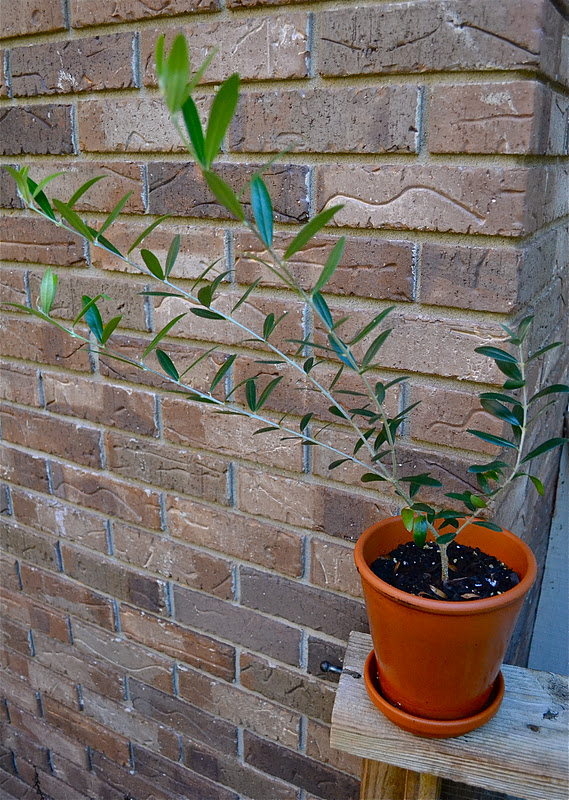
And, six months later, my little Charlie Brown olive tree is trying its best to grow into a real tree. 


I think it even needs a new pot.

Although I won't soon be using our own olives to make this recipe, it is pretty tasty, and with the holidays approaching, we can all use good, tasty, easy recipes, right? I suppose I'll go stand in line behind the coupon goddess to buy our olives at Publix.

Enjoy!

XO ~

Julie

Olive Tapenade with Feta (adapted from epicurious.com)
  • 1 1/4 cups pitted manzanilla olives (or other green Spanish olives)
  • 1 tablespoon drained capers
  • 1 large garlic clove, minced
  • 1 teaspoon fresh lemon juice
  • 1/4 cup extra virgin olive oil
  • 1 tablespoon chopped fresh parsley
  • ¼ cup feta cheese
  • Toasted baguette slices
Preparation
Combine olives, capers and garlic in food processor until well chopped. Gradually add lemon juice and oil and process until blended. Transfer tapenade to bowl. Stir in parsley and feta. Season to taste with pepper.
Serve tapenade with toasted baguette slices.

Friday, November 4, 2011

Thanksgiving Tomatoes.

It's curious. Why are salad greens and tomatoes irrevocably paired? In most zones, these garden staples don't grow during the same season—unless aided by a greenhouse. Who decided that diced tomatoes belonged on iceberg lettuce? (And does anyone still eat iceberg lettuce, which was the only green veggie that crossed my childhood lips?)

Obviously, the pairing of tomatoes and lettuce didn't originate with our local, sustainable farmers.

Still, I've always considered it a challenge to see if I could push the limits and actually prepare a homegrown salad with our own heirloom tomatoes and lettuce.

Last weekend, with an impending frost, I grabbed a large bowl, headed to the gardens, and harvested all of the decent looking tomatoes, peppers, and herbs before they succumbed to the weather. Peppers were sliced and frozen for winter fajitas, basil turned into pesto for a little taste of summer mid-winter, and the few ripe tomatoes were either eaten immediately or popped into freezer bags to use with pasta.

But the pile of unripe, green tomatoes towered on the counter.


I'm not a fan of unripe tomatoes. I know there are many pickling tips and recipes that employ green tomatoes as the star, but honestly—it's just not my thing. (Unless, of course, it's supposed to be a green tomato when it's all grown up, like Aunt Ruby's German Green or Green Apple. That's a different story.)

So, it was time for a little science experiment.

I've read various methods for ripening green tomatoes—put them in a box, hang the whole plant upside down in the garage. Instead, I opted for the easiest method that seemed most logical. Plus, all that I needed for said experiment was a paper bag. And a banana.

Now, that's my kind of experiment!

First, remove any leaves, stems, or dirt from the tomatoes. You don't want anything that can cause bruising. Only use fruit that is bug-free, at least three-fourths of its full size, and glossy green (or just beginning to ripen) for best results.

Place the tomatoes in the paper bag...


...add a ripening banana (please excuse this nasty banana. It's been in the bag and needs a replacement)...


...keep out of direct light, and voila! 


Within two weeks at 65-70 degrees, your fruit should ripen. (This tomato was completely green when I put it in the bag. The shoulders will remain green, because of its variety—Ananas Noir. It's an heirloom known for it's purple coloration with green shoulders.)

The banana helps speed the ripening process, as it releases ethylene. All fruits release ethylene, so you could also add a semi-ripe tomato into the bag with the green tomatoes, but bananas produce the most ethylene and quicken the process.


Isn't it amazing when something actually works?

Sadly, I won't be slicing tomatoes to serve on our homegrown lettuce. Somehow, I'm way behind schedule planting our fall garden, and our little lettuce plants are lingering in the driveway, begging to be transplanted into their home.

But first I have to clean up all of the blackish, frost murdered plants from the potager. And transplant strawberries. And get the beds ready for mulch.

Sigh.

Maybe I'll start a few tomato plants for the greenhouse, and when the lettuce is ready in the spring, we might have a real, homegrown salad. With tomatoes off the vine.

A girl can dream...

So, quick! Go rescue your green tomatoes before the frost hits.

And perhaps, if you're better organized than I am, you can have a homegrown salad with Thanksgiving dinner.

Enjoy!

XOXO ~

Julie