There's a reason I'm not a food blogger. I lack the required domestic genes. I love food. I love beautiful food. But I can't create beautiful food.
I try. Truly. I drool over slick foodie magazines. I bookmark lovely recipes from my favorite food blogs, like The Pioneer Woman or Orangette. In fact, the vanilla bean scones from The Pioneer Woman's site are what inspired my latest culinary/crafty attempt.
Have you tried these scones? Oh. My. Even I think my attempt at replicating Ree's scones are darn delicious...
...if you eat them with your eyes closed. They don't look anything like her lovely, symmetrical scones. Mine are more like vanilla bean blobs...but they are tasty blobs.
People like me should stick to playing in the dirt and leave the prettifying of food to the experts.
But then—I don't always embrace commonsense.
So, in my efforts to make the scones look less horrific, I decided to try a little artsy craft, inspired by my weekend gardening chores.
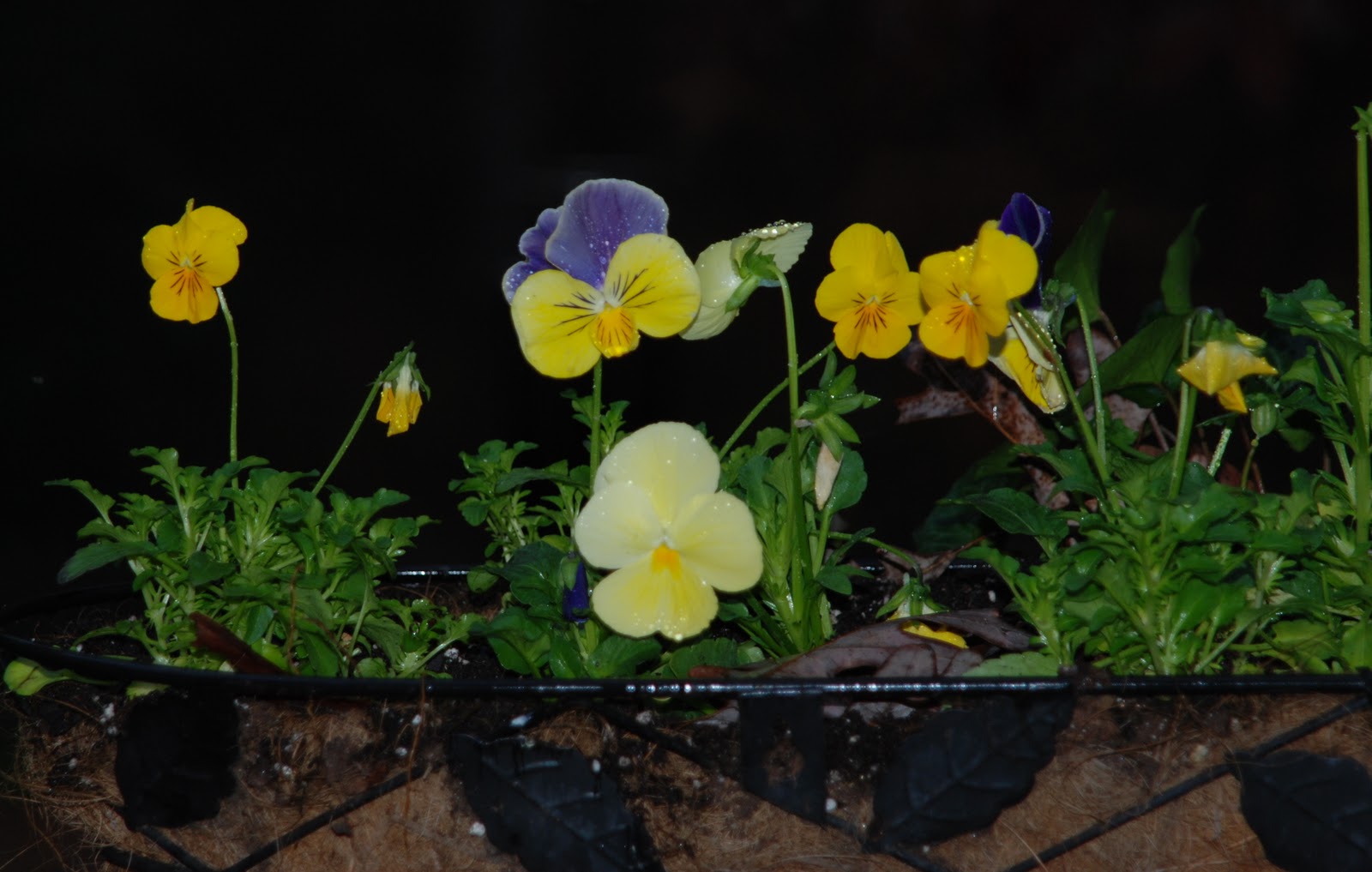
I planted pansies. Lots and lots of pansies.
I love pansies. They're just so stinking cheerful. Today is one of those dreary fall days when we gardener-types lament the end of summer. It's gray. It's raining. It's nap-inspiring. The banana tree is melting from the frost, it's yellow leaves drooping like the peel of its fruit. The lantana's leaves are crackling-black—or were, until I chopped them off Sunday. The beech trees look splendid, as do the Japanese maples...but I know those colors will be gone soon, too.
But pansies? They're my saviors on these bleak days.
Just look at their adorable little faces. Such personality! Such expression! Such a bright plop of color to fight off my bouts of Seasonal Affective Disorder!
In our zone 7b climate, pansies are the perfect pick-me-up for fall and winter gardens. When I lived in the north, pansies were a spring/summer flower—they wouldn't survive the sub-zero temperatures and drifts of lake-effect snow. But in Upstate SC? They surround our mailbox, line the front walk, huddle in containers on the deck. Violas guard the lettuces and brassicas in the potager.
And, occasionally, they are guinea pigs in my domestic goddess endeavors.
Pansies and violas not only add color to the garden—they are also edible flowers. Well—they're edible IF they are raised organically. Please be careful if you think you can start munching on the flowers at Lowe's or any other big-box store or nursery, because you may well get a mouthful of pesticides or chemical fertilizer. Just a warning--no lawsuits, please.
Pansies and violas have been valued throughout the ages. Since the 4th century B.C., the Greeks cultivated violas for herbal medicinal use. Much later, the viola inspired William Shakespeare's romantic writings.
The pansy, whose ancestor is the viola, was discover some time after the 4th century B.C. in Europe. Thriving in alpine meadows and on rocky ledges, the plant was named a wild pansy. Possibly, a person living in France may have discovered the plant, as the word pansy is traced back to the French word “pensee,” meaning thought or remembrance.
The early wild pansy (now known as Viola tricolor) was different from the viola. The wild pansy grew from the ground on one main stem, then branched above ground. Viola plants branch below ground with many plants sharing the same root system. The wild pansy bloom was larger than the diminutive viola. The popularity of the flower inspired much cross-breeding to produce different colorations and designs. Today, hundreds of varieties of pansies and violas are available in a rainbow of colors.
Pansies and violas continue to be popular with herbalists and confectioneries. From tea to cure coughs to decorative designs on cakes, the viola family is both ornamental and practical.
So. I faced a dozen ugly scones. Half a flat of pansies remained after my weekend planting frenzy. Why not try to hide my ugly scones under beautiful, edible flowers?
Seriously, how hard could it be to make crystalized pansies?
First, I picked a few flowers, washed them, and let them dry.
Aren't they cute?
Next, I added two teaspoons of meringue powder and two tablespoons of water to a shallow bowl, whisking until smooth. (Some recipes call for egg white...but with the recent egg debacle, I chose to use meringue powder to keep everyone healthy.)
Using a pair of tweezers, I attempted to hold the flower on its base and removed the stem with small scissors. Then I gave up on the tweezers.
I next applied a thin layer of the meringue mixture on each side of the flower with a small paintbrush.
(As you can see...the “hold with tweezers” step didn't work so well for me. What can I say? I'm a rule-breaker. And—are those my hands??? Where did those lines come from? Eek!)
The instructions said to "hold the blossom over a bowl or plate, and sprinkle superfine sugar over the entire flower. Repeat on reverse side." I just put the flower on the plate and sprinkled the sugar on it.
Finally, place the flowers on superfine sugar-covered parchment or waxed paper to dry. PLEASE NOTE: I missed the “sugar coated paper” step and just placed them on parchment...they stick. A lot. Definitely put a layer of sugar on the parchment first. You will be much happier.
The flowers should be dry in 2 - 4 hours. (Hmmm. It's been about 24 hours, and my flowers are still sticky. Perhaps I went overboard with my meringue painting?) I even turned them so they would dry evenly.
You can, apparently, freeze crystalized flowers for up to a year. I don't think I'll bother.
So, here it is—my ugly but yummy scone decorated with my crystalized pansy.
I don't think the pansy on the scone makes it look any better. It looks like a soggy pansy on a malformed scone. I think I'll stick to putting pansies in salad. Or dirt.
I accept that I'll never make it as a food blogger.
But my yard and containers make me happy. Until spring. Only 124 days until spring.
Years ago, when our oldest son, Tyler, was nine years old, we invited one of his neighborhood friends to join us on our annual apple orchard outing. Will is two years younger than Ty, and it just breaks my heart when I see this tall, muscular GUY next door shooting baskets. He's the youngest of Ty's neighborhood gang and always fought to keep up with the older boys. Soon he, too, will be off to college.
Sorry. A sentimental Mom-moment distracted me.
Anyway, we were out among the trees, and Peter picked a few apples. He handed one to each boy, then took a bite of his.
Will looked appalled.
“You can't do that,” he said, horrified.
“Don't worry, honey, we'll pay for everything when we get back.” What an honest boy, I thought.
“No,” he said, eyes wide. “You can't eat that.”
“Why not?”
Will looked at me like I was from another planet.
“It's not from Publix.”
~ ~ ~ ~ ~ ~ ~ ~ ~ ~ ~ ~ ~ ~ It's fall, and I'm thinking about apples. And remembering Will's innocence.
I'm also hoping that our kids always know the origins of their food, whether or not they actually eat it. (That would be asking too much, with the exception of apples. Oh, and strawberries.)
With the arrival of fall, I know I'm not alone in my apple preoccupation. My Facebook page is filled with pictures of friends' families hunting Granny Smiths, Golden Delicious, Jonagolds.
This year, we branched out and tried a different orchard, one in North Carolina. Normally, we visit a local orchard that's ten minues from our house—but truthfully, we've always gone for the experience rather than the apples. The apples at our local orchard are tasteless, even a little mealy. This year, I wanted a good variety of flavorful apples, even if it meant forsaking our (very) local orchard.
I'm glad we did.
Sky Top Orchard is exactly that—a lush, rolling, mountain-top orchard with stunning views. Located in Flat Rock, North Carolina, we visited early in the season, but the parking area was packed. With 40 acres to roam, though, the only places we really bumped into other visitors (besides the parking lot) was in the apple cider donut line.
Can you believe that I never tasted an apple cider donut before this fall? It's was pure sugar and grease and deliciousness. Heaven.
I'm not an apple expert. I've gone apple picking every year for probably the past 18 years...and I still don't remember which varieties are tart (besides Granny Smith), which are good for cooking, which are best fresh. During our apple hunting, I was certain Peter searched for a variety of apple that didn't exist (“Jonathan” versus “Jonagold”—the one I was familiar with). I started to tell him in my know-it-all wife voice that his search was futile...until we found his variety already pre-picked.
I just hate when he's right.
After a lovely family outing, I decided it was time to increase my knowledge of apple varieties. I started doing some research and found a great article on Saveur. It's my go-to guide now.
Do we honestly think I stopped there?
I'm now completely smitten with heirloom apples.
(Poor Peter, I haven't told him about my newest obsession. He'll be reading it here.)
Do you know about the Ark of Taste? Here's a quote from Slow Food's website:
“The Ark is an international catalog of foods that are threatened by industrial standardization, the regulations of large-scale distribution and environmental damage. In an effort to cultivate consumer demand—key to agricultural conservation—only the best tasting endangered foods make it onto the Ark.
“Since 1996, more than 800 products from over 50 countries have been added to the international Ark of Taste. The US Ark of Taste profiles over 200 rare regional foods, and is a tool that helps farmers, ranchers, fishers, chefs, retail grocers, educators and consumers celebrate our country's diverse biological, cultural and culinary heritage.”
The apple is an American icon. However, of the approximate 14,000 varieties that evolved from the seeds brought into North America by English settlers, today only 11 varieties comprise 90 percent of all apples consumed in the U.S. Those 11 varieties that dominate the produce aisles are grown in large commercial orchards, easily packed and shipped to far away locales. The perfect, glossy globes attract consumers—but flavor is sacrificed for shipablility and presentation.
One of the goals of Slow Food is to make consumers aware of varieties that are dying out due to mass production. It's Economics 101. By experiencing the unique, richer flavor of heirloom varieties, consumers will begin requesting heirlooms, and farmers will find a market to continue producing tasty, regional fruits. Sounds simplistic, doesn't it?
Of course, it's a much larger challenge.
So, in my own small effort to support heirloom varieties, I'm researching nurseries and varieties and figuring out how to tell Peter that we need a small orchard near the river.
I'm sure he'll be delighted. Stay tuned...
Until then, I'm taking an inventory of the apples waiting in the refrigerator. Not only did we bring home dozens of apples from our family's Sky Top outing, Michael and I also brought home apples from his kindergarten field trip.
It was a little sad. The kids picked apples—out of bins. So now, there's a generation of kids who think apples come from bins on farms. Hmm. Somehow, I don't think that was the point of the field trip.
Still, we are—literally—bursting with apples.
Fortunately, my family likes apples. They especially like apple desserts. Rather than my standard apple pie, I decided to try something new. I found a recipe on the blog, Orangette, for an excellent “Apple Tart Cake.” The author of the blog, Molly Wizenberg, stated that the tart is even better the second day. She's right. If you've never visited Orangette, please do. You'll be delighted.
So, before I get back to researching which heirloom apple trees would best fit my family's needs—some for eating fresh, some for cooking—I'm heading to the kitchen to make another Apple Tart Cake. You really want to try this recipe—it's easy, delicious, uses pantry staples, and has a rustic appeal. (My cake is not as pretty as the one on the Orangette blog, but it was tasty.)
You can use any variety of good, tart apples. What are your favorite varieties for cooking or fresh eating? I'd love to know.
So, head to the kitchen, pull out those apples from your orchard visit, and start peeling. You'll be so glad you did.
Apple Tart Cake Adapted from Orangette, originally posted January 19, 2009
Ingredients: 1 cup granulated sugar 1 cup all-purpose flour 1 tsp. baking powder 5 Tbsp. cold unsalted butter, cut into a few pieces 1 tsp. vanilla extract 1 large egg, lightly beaten 3 large Granny Smith apples, peeled, cored, and sliced very thinly
For topping: 3 Tbsp. granulated sugar 3 Tbsp. unsalted butter, melted and cooled slightly 1 tsp. ground cinnamon 1 large egg
Preheat oven to 350°. Butter and flour a 9-inch springform pan.
Combine the sugar, flour, and baking powder in a bowl. (I used my KitchenAid mixer, which worked fine, but the original recipe calls for use of a food processor.) Add the butter. Mix until no large lumps remain. Add the vanilla and the egg. Blend well. Mixture will be crumbly. Dump mixture into the prepared springform pan, using your fingers to gently press it along the bottom of the pan. If the dough sticks to your fingers, like it did with mine, just put a tad of flour on your fingertips. Make a slight, gentle, upward curve at the edges to form a low rim. Arrange the apple slices over the base in a tight circular pattern. Really overlap them. I didn't overlap the apples the first time I made it for fear they wouldn't cook well. My mistake. Place the pan on the middle rack in the oven, and bake for 45 minutes.
While the cake/tart is baking, prepare the topping. Combine the ingredients in a small bowl, and whisk to blend well. After the cake has baked for 45 minutes, remove it from the oven, and pour the topping evenly over it. Bake for another 25 minutes or so, until the topping looks set. Transfer the pan to a wire rack, and cool for 20 minutes. Then run a thin knife around the edge to release any areas that may have stuck, and remove the sides of the pan. Cool completely before serving.