Tuesday, September 28, 2010

Outstanding in the Barn.

Remember last week, when I wrote about my crazy issues with expectations? Well, after attending the amazing dinner produced by Outstanding in the Field at East Fork Farm, I assumed that no local farm-to-table event could possibly compare to Chef Dissen's delicious meal.

I was wrong.

Take one noble organization: Hub City Farmers' Market. Add 14 local producers, seven prestigious chefs, a wine expert, a dozen volunteers, a lovely location with delightful hosts, and you have the recipe for a fabulous evening.


The first annual Farm Dinner organized by Hub City Farmers' Market is proof that commitment to a cause inspires excellence. Hub City Farmers' Market is a not-for-profit organization, unlike Outstanding in the Field. The proceeds from the dinner benefit the organization's community gardens and farmers' markets, as well as the Mobile Market, which takes local, healthy food to several locations in Spartanburg County. The mission of the Hub City Farmers' Market is to increase the demand and availability of healthy food in Spartanburg County.

The Market staff are terrific people. Dedicated. Creative. Eager to introduce local producers to the community and, in the case of the Farm Dinner, the community to the producers. Foodies unite with farmers, bakers with buyers. Executive Director Ana Parra leads the organization, and her talents are instrumental in the growth of the market and its programs. The amount of preparation and attention to detail required for the inaugural farm dinner is a full-time job.


Live Oak Farms in Woodruff, SC, provided the perfect venue for a farm-to-table dinner. The hosts, Allison and Chuck Shaum, are committed to sustainability. Not only do they specialize in pasture raised, heritage breed animals, but their farm is a prototype for solar generated energy. The farm store, which stocks organic products, locally produced meats, certified naturally grown produce, and South Carolina seafood, is powered entirely by solar energy. Solar panels charge the electric fences surrounding the fields. The Schaums don't just talk about the environment—they protect the resources that provide their livelihood.

Did I mention that they are genuinely nice people? Allison is the kind of person who remembers everyone's name, who takes the time to listen to the crazy ravings of a customer who fears preparing her first organic, free-range turkey for Thanksgiving. She's also the mother of four children, so she's good at managing her high-maintenance customers like me.

I wish she lived next door.

After dropping Kristen off in Duncan for a sleepover and taking Michael to Simpsonville to spend the night with my sister and niece, we actually arrived at Live Oak Farms on time. Shocking. It's amazing how Peter and I are motivated by food...

But we weren't alone. The Schaum's barn was crowded with locavores, eager to support the cause. Or, perhaps the attendees weren't as altruistic as I imagine. Maybe they just wanted to feast. And drink.

No matter what the diners' motivations, they wouldn't be disappointed.

The setting was actually more formal than the Outstanding in the Field dinner. I know you're thinking: barn = formal? Really? OK, skeptics, take a look at the lovely tables...with assigned seating.


Our tablemates were terrific—two producers (Frances Davis from Windmill Hills Farm and Daniel Parson from Parson's Produce) whose vegetables starred in several of the courses, as well as the publisher of Edible Upcountry and the new business manager of Converse Deli. I've known Daniel through Hub City Farmer's Market, and he's an incredible source of information about organic practices. Plus, he's just a really good guy who beams when he talks about his baby.

I hope he snuck some dessert home for his wife, who stayed home with baby Ben.

Samantha Wallace is the force behind the Upstate's newest publication, Edible Upcountry. If you haven't seen the magazine yet, you can find copies of the premier issue at many local retail sources, including Live Oak Farms. The Upstate needed this publication—a source that brings providers and customers together, much like farm dinners. Through the publication, though, you can find more detailed, personal information about the growers, producers, and people behind local foods. It's a terrific resource, and I'm not just saying it because of the article about my seed saving venture.

Really.

While the food is, of course, the enticement for the farm dinner, the best entertainment is to watch people coming together in an effort to support one another. For instance, Daniel and Samantha had not previously met. I'm not sure how that's possible, but the dinner provided an opportunity for them to meet and talk a bit of shop. The manager of Converse Deli was equally happy to meet Daniel. Converse Deli supports local food, to the extent that they recently invested in a 10-acre farm. Until the farm produces the amount of food they require for the restaurant, Daniel might be a source.

All of this synergy occurred just at our table. Who knows what relationships formed among the other guests?

Back to the food.

Oh. My.


Is it possible to have too much food?

I tried to pace myself, really, I did. But with five courses paired with delicious wines, plus amazing breads (my downfall), plus dessert...I think I'm still in a food coma three days later.

Honestly, when there are seven chefs involved in a dinner, each course is designed to showcase that chef's talent. It's like “Top Chef,” but in this case, it's a friendly non-competition to benefit a good cause. Still—each chef wants to make certain that his or her course is delicious. And memorable. Our talented chefs included:


Patrick Wagner, Culinary Institute of the Carolinas at Greenville Technical College
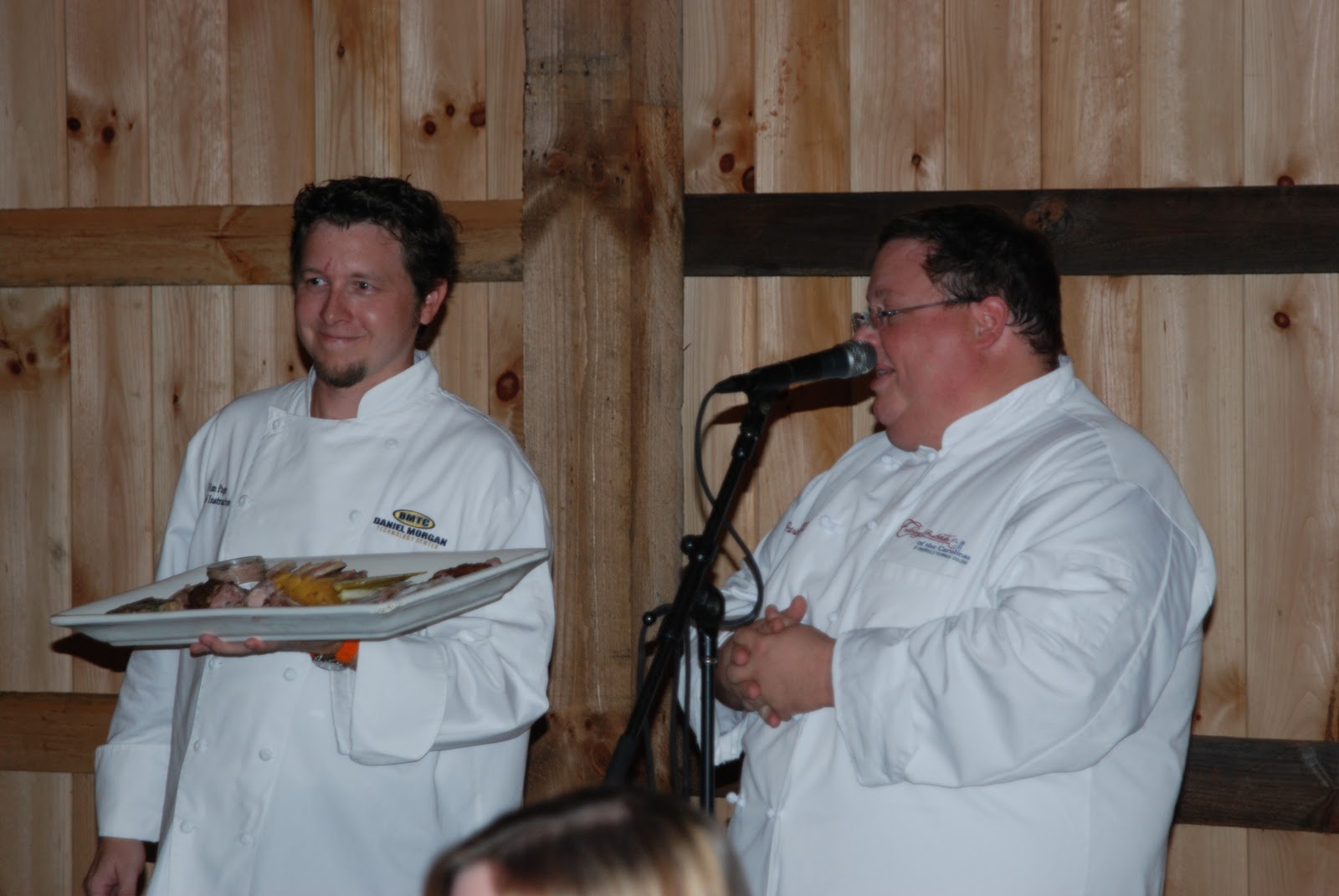
Tim Page, Daniel Morgan Technology Center
Gerhard Grommer, Gerhard's Cafe
Stephanie Tornatore, City Range
James P. McCalister, Milliken Guest House
Tray Mathis, Converse Deli
Anastasia Kaminski, R.D. Anderson Technology Center

Wine Pairings
Tony Forest, Carriage House Wine

We began with the Charcuterie tray. Taken from the term cuiseur de chair, meaning "cooker of meat," charcuterie is a French culinary art dating to the 15th century. Originally a method to preserve food prior to the advent of refrigeration, it typically refers to pork specialties such as pâtés, rillettes, galantines, and crépinettes, which are made and sold in a delicatessen-style shop. 
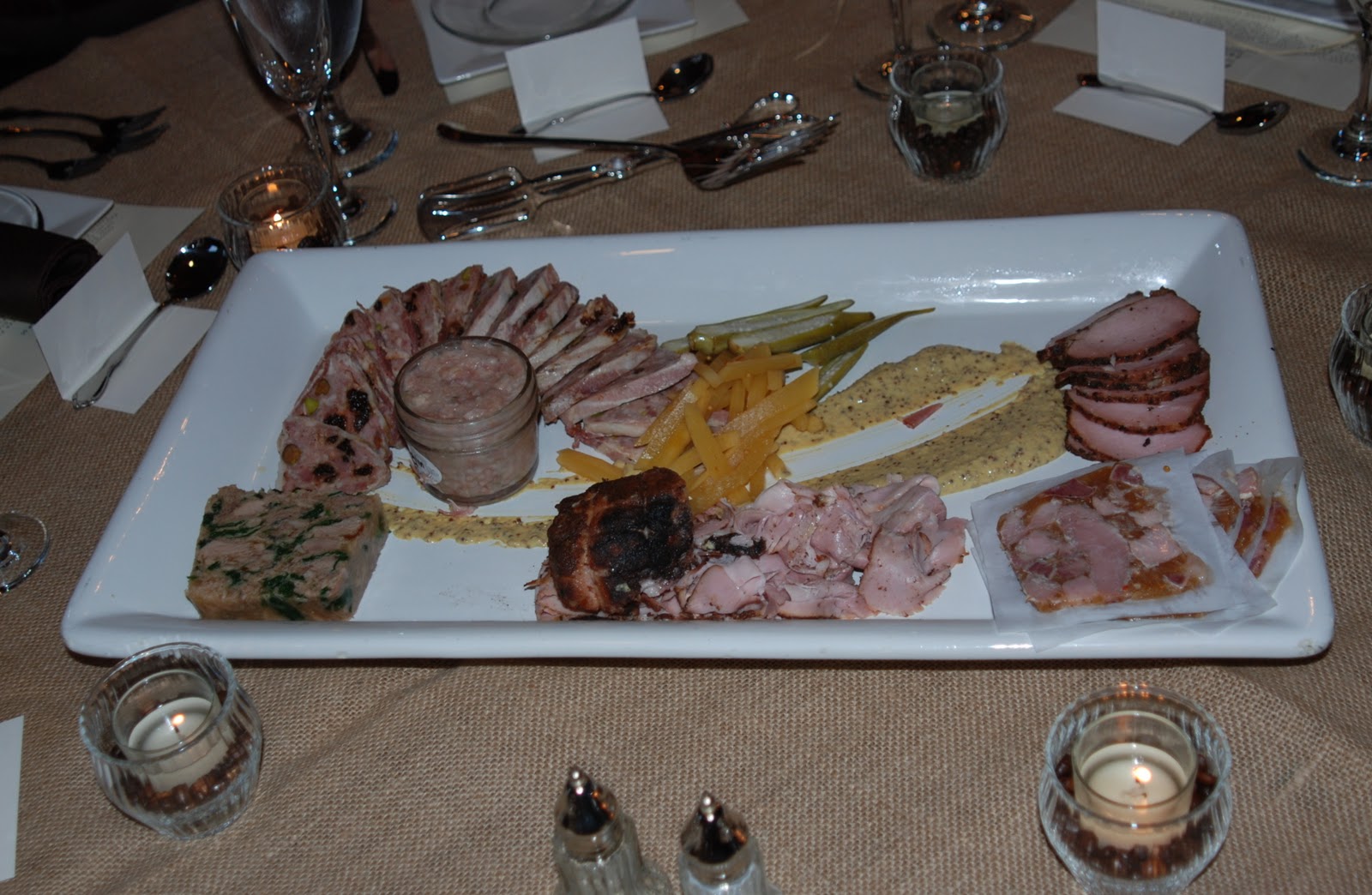

First Course: Charcuterie
Country Souse, Cajun Cured Pork Loins, Pork and Sweet Onion Rillets, Daube of Pork with Greens, Pastrami Cured Cottage Ham, Rustic Pate
Pickles/Condiments:
Boiled Peanut Relish, Garlic Pickled Okra, Bread and Butter Saffron Turnips.


Breads
Rosemary Sour Dough with Black Pepper and Live Oak Farms Asiago
Bee Well Honey and Wheat Sour Dough with Pecans
made by Tim Rogers

La Marca Prosecco


Boiled peanut relish? Oh. My. 
Who would have thought?  
OK. Honestly, I could have stopped here. Between the meat and the bread, I was in heaven.

I'm so glad I didn't.


Second Course:
Smoked Carolina Sunburst Trout with a Crayfish Butter on Toasted Brioche served with a Matignon of Brunoise Garden Vegetables and a Lime Coriander Vinaigrette.
Artisan Pinot Noir

How does one make Crayfish Butter?

You know, I don't really care. The trout and butter were scrumptious.


Third Course:
Broth from Rabbit and Chicken Served with Rabbit Loins Wrapped in Pancetta
Ravioli with Rabbit Confit and Sliced Butternut and Wilted Mustard Greens.
Rockhouse Viognier
 

This course won the showmanship award, with the broth poured at the table. The scent alone added about two inches to each of my thighs. 

The ravioli? Mmmmm.


Fourth Course:
Crispy Okra Salad ~ Crispy Okra, Mizuna Greens, Turnips, Hericoverts, Cilantro, Carrots, Red Onion, Tossed with Honey Cumin Vinaigrette.
La Playa Cabernet Rose


Delicious greens, courtesy our tablemate, Daniel, expertly prepared by Chef Stephanie Tornatore from City Range. 

Crispy fried okra is my new favorite food.
  
Fifth Course:
Seared Manchester Farms Quail Breast with a Local Corn and Fresh Bacon Succotash Topped with a Fig Gastrique
Artisan Pinot Noir

Or maybe my new favorite food is corn and bacon succotash. Bacon added to anything is good, but the corn was amazingly fresh on its own. My dad, a former farm boy, was a corn connoisseur. I know good corn.

At this point, I had a hard time sitting upright in my chair—and it wasn't due to too much wine. I needed a walk. Or a nap.

And then this arrived...


Dessert
Apple Franzipan Crumb Cake with Wine Poached Apples, Cinnamon Calvados Crème Anglaise and Toasted Candy Pecans.

And the cheese plate... 


Split Creek Goat Cheese and Apple Pecan Truffle, Blue Cheese with Caramelized Pear, Happy Cow Ricotta
JK Solstice Hard Cider


Oh. My.

Anyone who knows me also knows that I never leave dessert. Dessert is my favorite course.

I couldn't conquer it. I ate half, wanting to lick the plate clean of the crème...and tried to figure out how I could sneak the rest of the cake home.

I apologize to the goats and the artisans who produced the cheese plate. It was lovely, but I already looked and felt about eight months pregnant by this point in the meal.

Besides trying to figure out how I could discreetly take my dessert home, I was also trying to determine how I could get Peter to carry me to the car.

Unfortunately, Peter made me waddle to car on my own.

When we left, the party was still going strong. Chefs mingled with diners. Exhausted volunteers finally relaxed and drank wine. Shoppers visited the Shaum's farm store for more food...

More food? Who could possibly shop for food after eating five courses???

...and Peter and I went home, where I happily put on my oversized PJs...

Note to self: never wear control-top tights to a multi-course farm dinner.

Ouch.

Oh. My.


Friday, September 24, 2010

What's for Dinner?

It's 4 p.m. Well, actually, 4:10 p.m. I should be thinking about what to feed my family tonight. Instead, I've spent about 40 minutes playing on Facebook, 10 minutes sorting photos, two minutes thinking that I really should clean the house, and about 30 seconds justifying why I'm not cleaning the house. I mopped our (very) sticky kitchen floor earlier, though. Whew. I'm worn out.

Anyway, I decided that while the kiddos are busy playing outside with friends, I would share with you why I'm not stressing about what's for dinner.

We have sauce. Lots and lots of sauce.


With our abundance of tomatoes this summer, I've been on a midnight sauce-making frenzy. I've decided it's a great method to cure insomnia by making sauce at 11:30 p.m. (Then, sleeplessness is no longer frustrating insomnia, because I'm actively working.) The weird inner dialogues that happen in my brain...

While our overload of tomatoes was one reason for making sauce, the real reason I wanted to stock up is for days like today. Today, I don't have one creative idea of what to feed my family that will not illicit grief from the kids. I thought about risotto, which Peter and I love...but the kids despise. I thought about chicken, but right now, I'm having an anti-chicken phase. (This happens every few weeks, after I've been reading sustainable farming literature. We buy organic chicken, but still...some days, I just can't go there.) So, rather than do our fallback routine of going out, which has become too frequent, too expensive, and too questionable regarding our waistlines...I'm pulling out the sauce.

Everyone eats the sauce.

It's healthy. It's delicious. It's homemade from organically raised produce. Even the garlic is from our garden, which personally—I find very cool. 


Garlic is good. Homegrown garlic is great.

So, because I feel your pain as the dinner hour approaches, I'm sharing my super easy, incredibly scrumptious sauce recipe. Get to the Farmer's Market tomorrow morning, 8 a.m. SHARP. Buy tons of tomatoes, if you haven't grown your own. Tell the farmer that you need delicious, organic tomatoes to make a big vat of sauce, and you might get a price cut. Locally, one vendor sold 25 pounds of tomatoes for $10. Granted, they weren't heirloom, but they were organic. Make sure you select nice, ripe tomatoes.

ALERT! ALERT! ALERT!

I am not a chef. I am not even a very good cook. My recipe is one that I found on Cooks.com, and then modified to meet our personal likes. Extra garlic. Extra oregano. Extra wine.

You get the picture.

The beauty of this sauce is that it's fail-proof. It's great on it's own, but it's also fabulous with extra goodies, like mushrooms, sausage, and peppers. I make the basic sauce and then add the extra ingredients later, as we're preparing the meal.

Ready? It's time to get to work!


First, plug your iPod into the dock and line up your favorite tunes. Your hands will be covered in tomato goo for the next hour, so choose your selections wisely. If your teenage son recently downloaded new albums to your iPod, you may want to preview them before you begin. (Our college boy usually selects pretty good albums for me, but sorry—I'm too old for “Elf Power.” Did I really just admit that? Yeesh.)


One of the biggest hassles in making sauce is peeling the tomatoes. Do you know the secret for easy peeling? If not, I'm going to tell you. You will thank me.

Peel tomatoes.
Fill a large pot with water and heat on high to boil. Fill another large container with cold water and ice. Make sure it's near the stove.

After washing your tomatoes,  slice a shallow “X” in the bottom (blossom) end of the fruit. 


When you've “Xed” the tomatoes, add them to the boiling water for about one minute. 


Using a slotted spoon, remove the tomatoes from the pot and plunge them into the bowl of ice water. The ice water stops the tomato from cooking and further loosens the skin.

Remove the cooled tomato. The skin should peel away easily. (FYI—this also works for ripe peaches.) 


Crazy-easy, huh?

De-seed tomatoes.
Really, this is optional. We just don't like a lot of seeds in our sauce. If you're pressed for time, you can skip this step...

Cut the peeled tomatoes through the center of the fruit—not through the stem end. Squeeze the seeds and juice into a bowl. 


DO NOT THROW THIS OUT—just set it aside. You won't eliminate all of the seeds, so don't stress about removing every last one.

Cut tomatoes. Chop, dice, whatever makes you happy.

Remove the stem with your knife. It's hard and nasty—you don't want it in your sauce. Chop the tomatoes. The size isn't too important—the tomatoes are going to cook down, but if you don't like large chunks in your sauce—you'll want smaller pieces. Set aside.

Strain the juice.

I'm not big on kitchen gadgets, but I have to admit—I truly love my food mill for times like this. (A year ago, I didn't know what a food mill was, so don't feel bad if you don't, either.)


The food mill is pretty fabulous. It has legs that support it over a bowl, so while you're pouring seedy juice into it, you don't have to try to balance the food mill at the same time. So—pour in the seeds, juice, pulp...crank the handle of the mill a bit until most of the liquid is in the bowl—and voila! 

Lovely juice without seeds.

If you don't have a food mill, a fine strainer will work.

(Note: you can use the food mill to process the entire tomato, and it will remove the skin, seeds, and everything...but I found it makes the sauce too thin.)

OK. Still there? The hardest part is DONE! YEA! Wash your hands, get the tomato goo out from under your nails, drink a little wine, and get ready to cook!

Onions, garlic, and olive oil, oh my.
Chop your onions and mince your garlic. We like a lot of garlic, so modify the amount to your taste.

Heat olive oil in a large sauce pan. Add the onions and garlic, cooking until soft. (Just a couple of minutes.)


The herbs.
If you have fresh basil and oregano—use it, your hands will smell wonderful! Chop the fresh basil and oregano until fine. If you don't have fresh herbs, dried works fine, too.


The rest.

Add the tomatoes and seed-free juice.... 


...the wine...


...and all remaining ingredients (salt, pepper, sugar, herbs, wine) to the pot. 


Stir well, cover, and bring to a boil on medium-high heat.
 
Once the sauce begins to boil, remove cover, reduce heat, and simmer for about three hours.

The most important step.

Cut or tear some good bread, and dip into the sauce every hour, just to make sure it's to your taste. You can always add more spices to suit your palate.

And finally—pour a large glass of wine, go sit down, and bribe your husband/significant other/roommate to clean up the kitchen. When he/she smells the sauce, you'll have a kitchen slave. (Except mine was out of town when I made the last batch. Boo.)

Winter days.


The greatest thing about this sauce is that it freezes beautifully. Wait for it to thoroughly cool, ladle the sauce into freezer-safe containers (size dependent on your needs), pop into the freezer—and you'll have the taste of summer all winter long.

And when the witching hour hits, you'll no longer wonder what's for dinner.

Enjoy!

 ~ ~ ~ ~ ~ ~ ~ ~ ~

Homemade Tomato Sauce
¼ c. olive oil
6 cloves garlic, minced (modify to your taste—we like a lot of garlic)
2 medium onions, finely chopped
20+ ripe tomatoes, peeled, deseeded, and chopped
½ cup dry white wine
2 tsp. oregano
2 tsp. fresh basil, chopped
1 tbsp. sugar
2 tsp. salt
1 tsp. pepper

In a large, heavy pot, heat olive oil on medium high. Add garlic and onions. Saute until soft.
Add all remaining ingredients to pot, mixing well. Cover, and cook until boiling over medium-high heat. Reduce heat, remove cover, and simmer for at least three hours. Stir occasionally.

Tuesday, September 21, 2010

Outstanding. (In the Field.)


I admit it. I get easily excited. My expectations about an event—whether it's a birthday, Christmas, vacation, outing—often build to colossal proportions. The problem with having huge expectations is—it can set the stage for disappointment.

So, when I read about a farm dinner in North Carolina, my husband was skeptical. Knowing how my enthusiasm takes flight, he envisioned an overpriced rustic meal, swatting mosquitoes while listening to pretentious foodies debate the merits of arugula versus mizuno. Meanwhile, I fantasized about bonding with farmers and talking tomatoes into the wee hours while sipping wine under the stars.

No amount of imagination could prepare us for our blissed-out reality.

The fantasy.
Outstanding in the Field (OITF) is a “roving culinary adventure,” to quote the website. Founded in 1999 by Californian Jim Denevan as a way to connect food lovers with food origins, the elaborate field dinners showcase and honor local farmers, growers, food artisans, and chefs.

Denevan is a dreamer—a chef, land artist, surfer, cowboy-hat-wearing showman. His dinners draw locavores in droves to dine with the folks who raise the meat, grow the tomatoes, bake the bread, and process the cheese. The ingredients for the dinner are local, and diners break bread with the bakers who prepared it.

Denevan and his crew travel the country via the OITF bus, with dinners originating each season in California, cruising their way across the country, then heading back to home base. In the 2010 season, OITF will host 68 dinners, with the majority of the events sold out.

Central to the experience is the long table. It stretches throughout fields, curves within coves, and serpentines through stalks. The long table awaits, outfitted in stark white cloth, spare and minimal to showcase the surroundings. And the food. Oh my. The food.

First...

After dropping the kids off at my sister's house, we raced two hours into Marshall, North Carolina, winding our way up mountains...and wondering how we'd survive our way down after a wine-laden meal. Passing pristine farms and those harboring an abundance of old tires in front yards, we followed the signs to East Fork Farm...waiting for the mountains to open up to farmland.

Of course, when you raise sheep, you don't really require a flat field. Instead, we parked and walked up a hilly road, where our chauffeur awaited.

There's something about a tractor ride that just makes people immediately friendly. Maybe it's the fact that you're basically sitting on a stranger's lap, or maybe it's the intertwining of arms around shoulders to brace for those rough bumps, hoping that your Secret Powder-fresh Scent holds out. Maybe it's the determination to have a great time, based of the price of the tickets. Whatever it is, we became buddies with our tractor-mates before the first sip of wine.

Surprisingly, especially for those of you who know us—we were among the first diners to arrive. Which provided ample opportunity to chat, drink, and start snacking.

Oh. My.

Our first little tasty treat originated a few feet from our gathering place. While we waited for all of the guests to arrive, we gathered in a field near a sheep-filled enclosure, which overlooked a smallish pond. Which had trout.

Which turned into smoked trout rillettes.

Oh. My.

We knew after that first bite my expectations were totally realistic.

The farm (and family).

Have you ever met someone and knew that if only you lived next door, that person would be your instant best friend? Have you ever looked at a child and thought how much she loves everything your own child adores? Did you ever just want to throw rational thinking into the pond with the trout and pick up and move?

Huh. I realize I sound a little stalker-ish.

Honestly, though, you would understand if you met the Robertson family. Stephen, Dawn, and their adorable girls welcomed us to their farm as if we were their dearest friends. Of course, there were 120 diners, so I suppose I'd have competition to be Dawn's new BFF.

East Fork Farm, the Robertson's home and livelihood, is located in the mountains of Madison County, NC, about 25 miles north of Asheville. The farm produces pasture-raised lamb, free-range poultry, rabbit (of which they are developing a prototype for a free-range environment,) and pond-raised trout.  All products are free from added hormones or antibiotics, and the farm is certified Animal Welfare Approved.


The Robertson's commitment to sustainable farming practices produces superior tasting, healthy meat products, while preserving and enhancing the ecological health of the farmland and water. For 13 years, the Robertsons have enjoyed a symbiotic relationship with the land—growing a family business while maintaining their commitment to treat the land with respect.

How can you not love these people?

Can't you imagine Kristen and this sweet pea being best friends?


The field.
After our farm tour (and several glasses of Alain Patriarche, Aligote, Bourgogne 2008), our hosts led us to the field.


The first sight of the long table, slightly curving through the field, sheep grazing on the hill behind, was breathtaking. Then, practicality set in, and I realized I needed to sit with my back to the lambs. Sorry, but I didn't think I could eat their brothers and/or sisters with them watching. I know, I know. Roll your eyes.


There is a lovely Tradition of the Plates at OITF dinners. Guests are asked to bring their own plates to the dinner, providing an eclectic mix of china and earthenware. The couple across the table from us stopped by an antique store and bought two plates. The woman's family had collected china by this particular American china manufacturer for three generations, and she delighted in telling me all about her collection.

Peter and I brought...nothing.

We forgot plates in our rush to grab blue blankey, Nintendo DSs, and books for the kids to take to their aunt's house.

No fear. The OITF crew provides extra plates for slackers like us. My plate reminded me of a grandmother's china...Peter's was decorated with seashells. Perfect.

Whew. I worried we might be eating off of non-sustainable Chinette.

The food.
Oh, the food. My words will never do it justice, and I fear the photographs won't, either. I wish you could smell and taste each dish and its wine pairing through your monitor...


Wild mushroom tart, mountain basil, mesclun greens, roasted beet vinaigrette, mixed organic radishes.
Jobard Chardonnay, Rully, Premier Cru 2007


Grilled leg of lamb, tomato jam, grilled corn, edamame and sweet pepper salad
Francois LeClerc, Pinot Noir
Gevrey-Chambertin Corbeaux, Premier Cru 2006


(Oops. I'm afraid I ate this dish before I could take a photo.)
Rabbit gumbo, okra, roasted fingerlings, rainbow Swiss chard, crispy Vidalia onions
Gabriel Billard, Pinot Noir, Pommard 2004

Cantaloupe cocktail, Cremant de Bourgogne, sourwood honey, fleur de sel


Bethany's blueberry, Bee's Knees pound cake, lemon crème fraiche

OITF works with a renown local chef in each dinner location, as well as local food artisans. Our brilliant chef, William Dissen from The Market Place restaurant in Asheville, is committed to local foods. As owner and Executive Chef of The Market Place, Dissen serves food produced and grown within a maximum 100-mile radius of Asheville.

Within that radius, our dinner included cheeses from Three Graces Dairy; Wake Robin Farm Breads; produce from Jake's Farm; meats from our hosts; and wines from France. Well, OK. That's a tad outside the 100 miles, but I'm not complaining.

Trust me. Pinot Noirs to die for.

The favorites.
Expectations? Check. Check. Check.

Truly, beyond the amazing food and wine, my favorite parts of the evening were all about the people. The connections. Chef Dissen brought along a fabulous staff who shared stories about each course—where it came from, how it was prepared, the special herbs used, the history of the wines. It was like dinner and storytime all wrapped into one.

The long table is actually a series of tables, and the meal is served family-style, with platters to share among eight guests. Just within our closest tables, three couples celebrated anniversaries: 29, 25, and 10. Peter's fear of foodie snobbery was (pretty much) unfounded, at least among our tablemates. The was no pretension, no attitude—just sheer pleasure of sharing a gorgeous meal and experience.

Denevan's desire to honor the local farmer through OITF is probably my favorite aspect of the evening. The OITF crew ushers the farmers and producers around the long table, introducing them to the diners and telling their stories. I talked heirlooms versus hybrids with the Missy from Jake's Farm while sipping wine under the stars.

Expectations? Check again.

The spontaneous applause for the growers, artisans, and chefs—as well as a sloppily orchestrated “wave” of cantaloupe cocktail glasses down the long table—proved that Denevan was on to something when he launched OITF. Farmers beamed. Growers glowed. Guests asked artisans for autographs. Sheep bleated, and we all erupted in applause when the wayward lamb caught up with the flock.


Outstanding in the field?

Yes. Yes, it was.

Wednesday, September 15, 2010

I'm back...

Hi.

Remember me?

I feel a little like a teenager, who blew off her date--and then wanted him back.

(Not that I ever did that.)

This is awkward.

I'm sorry I abandoned you. You know it wasn't intentional, right?

See, this little thing called Life got in the way of my writing. I know you've probably imagined the worst. But no, we didn't buy an SUV, I didn't take a job at Monsanto, and we haven't lost our Greenpeace membership.

Did I mention that I'm sorry?

If I tell you a story, will you forgive me? It might help you understand why I've been absent lately.


~~~~~
Once upon a time, there was a girl/woman/mom who loved to garden. She loved to garden so much that she would dream of flowers. She would garden all day. She would garden at night—in the dark. On Mother's Day, while her friends visited spas, her wish was to plant the vegetable garden. In the rain.


Eventually, she realized her gardening habit had become an obsession. At about this same time, she also realized that soon her youngest child would be firmly ensconced in that lovely institution called kindergarten. Because she had no desire to return to her former life as a PR exec, she knew it was time to turn the obsession into something more. A business. A green business. A green gardening business.


Garden Delights.

The end.

~~~~~

Actually, there's a little more to it. Like:
  • 130 varieties of heirloom tomato plants
  • 35 varieties of heirloom pepper plants
  • Dozens of herbs and assorted heirloom veggies
  • 5,000 seedlings growing in the downstairs of our house
  • A commitment to use only organic methods and sustainable resources, including all shipping supplies and potting materials
  • Even the plant labels biodegrade in a home compost system

Oh. Did I mention that many of the plants I'm growing are in danger of extinction? And that through my business, I'm hoping to encourage a new generation of organic kitchen gardeners?

Then, of course, there's the marketing, selling, writing, tending, babying, nurturing, and general coddling that both the plants and the business required.

Oh. And the family. Yep, they had needs, too.


So, there it is. I abandoned my writing for a bit, but not my greenish ways. If anything, starting Garden Delights has been an enormous learning experience in finding fabulous renewable resources—and not settling for less. It's been crazy, hairy, frustrating, and delightful...and time-consuming.

I love it.

So, I hope you'll check in now and then, because I'd love to renew our green conversations. While I've been seeding and weeding, with my nose in fish emulsion fertilizer (nasty, good stuff)--what have you been up to? Learned any good environmental lessons lately? Have some tips to share? I'd love to hear!

Happy growing and greening!
XO

Julie

Monday, February 8, 2010

Book worm.


In case you hadn't noticed, I've been less than consistent in my writing lately. I'm distracted. Now, it would be easy to blame my lack of writing on my heirloom plant business start-up. Or the kids' crazy schedules, burning fossil fuels while we run all over town for violin, piano, and horseback riding lessons. Or the stinking cold that I just cannot shake. Or the deep cleaning that I do on a daily basis to ensure a spotless household.

Ha. You know I'm lying if I told you I'd been spending my time cleaning.

Instead, I'm distracted by a mesmerizing tale of history, intrigue, and scandal.

No, I'm not talking about our Governor.

It's Nefertiti. It's consuming. It's deliciously evil. It's historically engaging. It's a lovely escape from bleak winter days.

Yes, I'll admit. I'm a book-a-holic.


Once I'm engrossed in a great read, it's impossible for me to multi-task. I NEED to finish the book. I NEED to find resolution for the characters. Only then can I get back to real life. My reading obsession causes problems in terms of sticking to tasks. I've always been like this, though, since I was little. My mom would take me to the library and leave me there for hours. (This was when it was perfectly safe to do such things. Today, DSS would be knocking at your door, so I don't recommend dropping your five-year-old off at the library alone.) The nice librarian befriended me, letting me stamp the due date on the check-out cards. I read, and read...and read some more...until the librarian finally let me start checking out books from the adult section when I was about six or seven.

It was bliss.

Today, my reading obsession continues. I read when I go to sleep, I forgo sleep so I can read, I read when I should be cleaning the house, I read when I dry my hair, which explains why my hair always looks like crap. Books, magazines, newspapers, online articles...I'll read anything.

Lately, though, reading has become hazardous to my health.
Take, for instance, the day my nightstand fell over, with the (very heavy) pile of books and magazines crashing on my toe. Or the time I tripped over the pile of books awaiting storage, when I was trying to avoid falling over the dogs.

Something needs to be done.


The problem is—our entire family is book obsessed. OK, it's not really a problem—unless you're trying to make an effort to become a greener family.


About two years ago, Peter and I bought four lovely, double-doored bookcases. As unorganized as I am about things like laundry—I'm completely OCD about my books. One set of shelves is for Peter's German-language books, one for non-fiction, sorted by genre, alpha by author, a few shelves are devoted to my grandmother's books, and the last two cases store my fiction collection from the past few years. (Again, alpha by author.) Standing in front of the bookshelves is always Zen-like for me—a place that is actually neat and orderly that contains some of my favorite literary memories.


In addition to those shelves, each child has a bookshelf in his or her room, lovingly painted or stained by Daddy. We have a bookshelf in the downstairs hallway for overflow kids books. I have a bookshelf in the office that houses all of my gardening books, and Peter has two bookshelves—also in our home office.

Now, add into the fact that we just recently cleaned out the storage rooms downstairs, where I found boxes and boxes of books from my childhood. Then, the following weekend, while cleaning out my parents' house...I came home with four more boxes of books.


Do you see a theme here? We have no more room for books.

Yet, I continue to buy them. And I can't get rid of them.


As for magazines--it's truly a sickness. Gardening, sailing, current affairs, parenting, organic living, Ranger Rick, American Girl...our mailbox overflows. Our poor maillady. Where once, long ago, I was obsessed with the latest fashion trends, my shopping obsession is now seeds, books, and magazines.

So, in my effort to add a greener hue to our family, what's a girl to do without sacrificing everyone's favorite activity?


I'm not sure.

But remember, this little blog is about baby steps...easy to implement ideas to make a less negative impact on the environment. I know, for instance, that I will not relinquish my Barnes and Noble membership.

Still, there are some steps we can take—and have taken—to get our reading fix without killing more trees.


Realize.

Conservatree, a non-profit organization which once was part of the paper industry and now consults with businesses to provide recycled or non-paper sources for products, approximates that 17 trees are cut to produce one ton of paper. Now, granted, there are varying degrees of paper quality, pulp input, thicknesses, etc. But honestly, I just can't cite all of those statistics and formulas to you, because, well...I have a cold, and I think my head will implode if I attempt to explain the math. If you'd like to find information about calculating the number of trees used per various media, visit www.consevatree.org.


Suffice it to say—bestsellers use a lot of paper. Whether it's virgin hardwood, softwoods or recycled paper, the environmental impact of the printing industry is enormous. I know. I used to work in publishing. While recycled paper is a better alternative to deforestation, the energy consumed to produce the end product is high. But so is processing virgin wood into paper.

Reduce.
In my young days, the idea of reducing the amount of reading materials available to me would have been unthinkable. Fast-forward a few decades...to the land of Al Gore's Internet (you know I love him, but I just had to say it!), and the feasibility of reducing the stacks of papers and books—and saving some trees along the way--becomes more of a reality.


While I don't think reading a Kindle will ever have the same sensory appeal to me as cracking the spine of a brand new novel, technology's evolution allows for easy access to online news. Magazines. Books. Blogs, celebrity entertainment sites, shopping catalogs. You want to read it or browse it? Google it, and it's yours. Instant gratification.


One of my favorite things to do when I was growing up was to pull out the World Book Encyclopedias. Remember those? I'd pick a letter, start at the beginning, and just read. Today, the Internet serves the purpose of finding quick answers to questions—but does it provide the same ability to browse and stumble upon information that you didn't necessarily NEED to know...but that's good to know? How will today's kids win at Trivial Pursuit if they don't get lost in an encyclopedia?

Does anyone still play Trivial Pursuit?


I swear, the World Book still should be a mainstay in every household. Even though it's not remotely environmentally friendly. Nor very up-to-date.


OK, back on topic. So—what is the Adolf family willing to do to reduce our environmental impact without sacrificing our love of the written word?


Renew the Overdue.
I love the library, and it seems like such a simple solution. My children love the library. The library is a haven where anything is possible, where anyone regardless of socio-economic status or education level can learn, read, and grow. Thousands of books, just waiting to inspire...


But right now, we are in serious overdue debt. Why oh why can't I get the books back on time? Yes, I'll admit, to the shame of my sister, who never had an overdue library book in her life—I am terrible at returning books on time. It's not that we can't pay our overdue fees...I'm just mortified, because it happens far too often.

Still—we will get back on track with our library visits. I mean, really—when you can request the latest popular novels through the library's online catalog, reserve them in your PJs, and DRIVE TRHOUGH to pick up the books placed on hold...it's inexcusable not to take full advantage of the library.

Review. And opt out.

We cancelled our newspaper.

Honestly, that was not a big sacrifice for me. Our local paper is not The New York Times. It's more like the Hammond Times, my hometown local newspaper that our 11th-grade advanced English composition teacher, Mary Yorke, would hand out during class. We had to take red pens and circle all of the errors in spelling, grammar, and punctuation. So, no—that wasn't too tough to give up.


Or to try to give up.

Although we haven't renewed our subscription, we keep receiving the newspaper EVERY DAY. I've called. It arrives, every morning, mocking my futile attempt to rid our lives of one piece of un-environmental reading material. The irony is—a friend just posted on Facebook about the inability of her paperboy (paper-person?) to deliver her Sunday newspaper.

I can't get ours to stop.


So, I continue to pile it up. The good news about newspaper—I can use it as a weed block in the garden. I lay the thickness of about four sheets of newspaper, wet it, and then put mulch on top. It's an excellent, biodegradable source to smother grass and weeds when you're making a new garden bed—or prettifying an old one.


We've cancelled (all but the most important) magazines.
I'm such a hypocrite, though. I love Mother Earth News and will continue to buy it, even though I can access it online. You'd think that would be an obvious choice to cut out of our reading consumption, but no...I just can't. I save them and use them as a resource. Really. Thus the problem with my lack of space on bookshelves.

I know you're rolling your eyes at the irony here.


I did, however, get rid of almost a dozen subscriptions, including my formerly beloved People Magazine. The reality is—I honestly don't know any of the new stars that are about Tyler's age. I think I'm officially above the magazine's age demographic now, although I will always miss the pics of George Clooney. Ah, the sacrifice I'm making for the environment.

But what about the plethora of books?


Recycle.
OK, I'm on a cheesy roll right now, with my environmental “Rs”...but with books, I can't throw them away. I also can't stand the thought of recycling just the paper within the book—it seems sacrilegious to tear apart a book.

Still, there are many options to explore for recycling books.


Lend.

I'm a lender. I'm like my own little lending library. I always wanted to be a librarian, and this is my chance to play at it. I love to loan books to people, because there's nothing better than sharing a story that I found moving or interesting or crazy—and then getting to talk to the friend about the book. I also feel less wasteful in buying books, because I know I'll eventually share them with someone. Still...it doesn't solve my tree-killing issues.

Swap.

A friend recently introduced me to online book exchanges, which I'm going to try out. I've just signed up for paperbackswap.com and bookmooch.com. These sites provide a forum for you to list books you're willing to exchange with other members—for free, only paying postage. In return, you list which books you're looking for. I've heard great things about these online sites, so I'll let you know about my experience. Please—let me know if you've used them!

Donate.

Our local library benefits from donated books by holding an annual “Friends of the Library” sale. Not only do your used books support a terrific cause, but you can clean up on some great bargains—and restock your shelves with recycled books. Additionally, many literacy organizations sponsor book sales to support their organizations. Again, a fantastic opportunity to support a great cause and find some good deals as well.

I wonder if there's a way to calculate the carbon offset by donating books to charitable causes? Hmmm...I'm sure someone will think of a way to greenwash it....


If you don't have a local organization who sponsors a book sale, consider donating your used books to schools, used magazines (minus your address label) to doctors' offices waiting rooms, or both to senior centers or assisted living facilities. Additionally, when Kristen was in kindergarten, her teacher was delighted to take five boxes of magazines off my hands to use for class projects. Preschools are another good outlet for used magazines...cut, cut, cut!


Freecycle.

Have a bunch of books or magazines that you're ready to part with? Post them on Freecycle.org. If it's free, they will come...and you'll clear some shelf space.

Resell.

Want to make a few dollars to help offset your purchasing habits? Look for local used bookstores who will give you credits for the books you give them, allowing you to find new sources of reading pleasure at a discount. Used bookstores are wonderful—you get great books at a fraction of the new price, plus since you're buying used books—you don't need to feel guilty about the amount of trees that met the ax for your book!

E-bay your books, and find used books online. Amazon and Barnes and Noble, two of my favorite online haunts, often show “used” options from third-party vendors. Many of my gardening books, which can often be very expensive new, are through used vendors. The vendors list the price, as well as the condition of the book so that there are no unpleasant surprises upon receipt. Just keep an eye on shipping costs—I've had an instance where I found a book for $1.99—and the shipping was $6.99. Hmmm.

Are you still with me?

It's getting a little long, isn't it?

Ironically enough, Mikey just came and asked me to read a “Jack and Annie” book to him (aka Magic Tree House), and how can I say no? Did I mention that my little pumpkin is now reading as of last week? He read eight beginning reading books to me, and I'm so thrilled.
Another reader in the family...

So, I must run and read a bit to my boy. But we're not done with this conversation. Next, I want to figure out how to control the plethora of paper in the house...school papers, bills, clutter, packaging, kids' art projects...it's overwhelming me! I swear, it breeds at night.


But before we begin that topic, I'm curious: do you have a Kindle or other electronic book device? Do you like it? I'd love to hear your opinion...please share!


Until next time ~


Happy reading!

Monday, January 25, 2010

Revenge of the Recycled Cat.

Our house is, quite literally, a zoo. With three dogs, two cats, a bunny, and two aquariums of fish, we spend an exorbitant amount of money on pet food and vet visits. But, that's the commitment we made when we added these furry friends to the family. Or should I say—when Kristen added them to the family.

We started with one
dog—Maxi, a purebred Dalmatian.

I know, I know...shame on me.

Next, we added Mimi the bunny, who actually turned out to be a boy. Let's just say—identifying bunny gender is not as easy as you would think.

Then came Murphy, a tiny little black kitten, who decided to find shelter from the rain—under the hood of Peter's car. Peter drove home from work, heard meowing in the garage, and found Murphy stuck near the engine in his car. I never wanted a cat. I'm allergic to cats. I'm a dog girl. Kristen saw Murphy. We had a cat. Actually, the cat was originally named Mia--until Peter took her to get spayed and discovered Mia needed to be neutered. Obviously, pet gender ID is not our strength.

Around this time, Peter found two baby sq
uirrels that were abandoned. Guess who hand raised squirrels? And I wonder where Kristen gets her animal obsession? As soon as the squirrels were old enough, we released them into our backyard. Those ungrateful things came back often to eat the heads off of my pansies.

Next, Ringo. For whatever masochistic reason, we decided it was time for a puppy. Ringo was our first experience with adopting from a shelter
. Peter and I thought we would visit a few shelters, take a look, and think about adopting a pup. Of course, we left the shelter that day with Ringo. He was a sweetheart of a dog, chewed everything in sight, and loved Peter. The feeling was mutual. Murphy, however, did not love Ringo—and disappeared. Heartbreak. And then Maxi and Ringo got out of our fenced yard. Devastation.

RIP Ringo.


A month later, I received an e-mail. Our friend's son adopted a puppy with his girlfriend, not realizing how difficult it would be to care for a dog while in college. In an apartment. Would we be interested in adopting the pup? What do you think?

Chloe joined the pack. During the summer, we suddenly noticed two cats hanging around. Remember that I'm not a cat person? Well, starving animals break my heart, and these guys obviously had been abandoned. Oreo is part dog—she's mine. She comes when you call her, and jumps up like a dog to be petted. Someone cared enough to microchip her—but never updated the contact information. Sammy belongs to Kristen. For a very long time, he would only let Kiki the animal whisperer pet him. Now, he's gotten less nervous with the rest of us...but he's also turned into the true Tom cat, with torn ears and a scratched nose as battle wounds. We figured he had found a girlfriend, and decided it was time for the prowling to be done for Sammy.

So, last Friday, Sammy underwent the knife. Needless to say, he was not a happy fellow.

He sprayed.

Have you ever experienced cat spray?
Skunk couldn't be worse. Honestly. I feel well-punished. My car stinks. The entire house stinks. The downstairs, where Sammy is recuperating in a kennel, reeks. Friday night I woke up choking on the smell.

Please don't stop by—because I really can't let you in the house.

After several days of opening windows and doors i
n the freezing weather, along with various odor neutralizing sprays, we're starting to breathe again...but Sammy's revenge still lingers.

It's funny, because when thinking about pets and environmental issues, I realized that—with the exception of Maxi, who is spayed but from a breeder—we're pretty eco-savvy about our animals. I worried that we don't feed them organic pet food, we don't buy toys made from 100% organic cotton, we don't use hemp leashes. Still...we do two of the most important ecological actions as pet owners:

We adopt.

Whether it's from a shelter, from a friend, or taking in a stray, our pets are “recycled.” According to the Humane Society, between six million and eight million animals enter U.S shelters each year...and approximately four million dogs and cats are euthanized annually. That's about one every eight seconds. Not all of these animals
are strays—many are the offspring of well-loved family pets. Puppies and kitties are cute...but they grow into cats and dogs. It's never a good idea to let a pet have “just one” litter. There are too many animals in shelters who need good homes.

We spay and neuter our pets.

Yes, we got punished for it by Sammy. Still, Sammy is an outside cat. I don't want to be responsible for his inability to practice safe sex. Spaying and neutering is the only way to ensure population control. If, as a pet owner, you want to be truly environmental—forgo the organic cotton Halloween costume for Fido and get him
neutered instead.


Sophie, our sweet little third pup who Peter found starving in the company's parking lot, is soon due for her spaying appointment. Thank goodness dogs are so much more civilized than cats...here's hoping for a much less odorific experience.

Did you know that the Humane Society sponsors a Spay Day photo contest? The site states: “Capture your pet’s essence in images and words, win a great prize.” Hmm. I wonder if I could capture Sammy's essence and submit it?

Anyway—it's a cool promotion with a great environmental message. Check it out: www.humanesociety.org/news/press_releases/2010/01/spay_day_2010_photo_contest_012110.html

I'm off to scrub the house...again. For you animal lovers, we'll continue our chat about environmental pets next time with interesting eco products and ideas to minimize Spot's carbon paw print.

Until then...have any great ways that you minimize your pet's impact on the environment? Do you have a “recycled” pet? Please share!

Friday, January 15, 2010

Holiday recap.

Well. That was a pretty long food coma, huh?

I'm slowly re-emerging from post-holiday lethargy. I know—you thought the Adolfs had gone off the green wagon. You thought we couldn't handle the pressure of forgoing Christmas traditions that involve non-LED lights. You thought we'd cave and let Santa bring crappy plastic toys that will soon litter the landfill. You assumed we couldn't handle the pressure of a non-battery-driven, non-electronic Christmas.

You're right.

Yes, I failed miserably at the greening of our holidays. I knew I would. I hate to say it, but I know how I am at Christmas time. I am a holiday fanatic. I love the lights, I love aimlessly driving around, looking at decorations. I'm the first to suggest that we pile in the van (not Prius) and drive to the zoo where there are millions of energy-wasting lights. You can drive into the “Deer Forest” and feed the animals out of your car, all while wasting gas as the car idles with the heat on, doors open. I try to be good and order presents online—but then they arrive, with the non-recycled boxes, plastic, and styrofoam peanuts consuming the house. I still send the old-fashioned Christmas cards and will probably never embrace e-cards. We bake too much, indulge too much, and throw away too much. It's a glutton's dream.

So, I suppose, I've been a little ashamed to write about our family's “green-ness” after our holiday lapse. There were, however, a few things we did right:

We recycled. A LOT.

In Christmases past, I must admit to throwing away bags and bags of trash, just to get the clutter out of the way. This year, we made a very concerted effort to recycle anything and everything we could. During our present-opening frenzies, both at home and at my sister's house, we took the time to separate paper, cardboard, and plastic that could be recycled. We took bows that weren't crushed and put them away to reuse. In past years, our trash can overflowed after Christmas. In fact, our neighbors next door, in addition to their two trash cans, had at least a dozen trash bags at the street post-Christmas.

We didn't even fill one-third of a trash bag. We had a very large recycling run.

VERY large. I still have piles of boxes that need to go to recycling. But at least they're not headed for the landfill, as in Christmases past.

We turned down the heat. WAY down.

This fall, when it began getting chilly, I think I shocked Peter by my insistence to keep the thermostat down. OK, in truth, it's really not that far down. However, I'm the one who usually keeps the temperature set at 72 degrees. I'm cold. Always. When I get tired, I freeze. And, since I'm always tired, I'm always cold. Still, I was determined to keep the temp at the more environmentally friendly 68 degrees. I know, I know...it's not that great. Lots of the greenies of the world turn it way down, and there's a cult of green gurus who try not to use heat AT ALL. Have you heard about these environmental gods and goddesses who forsake heat? Good luck to those dedicated souls...but can't people die without heat?

Anyway, as a mom, I'm a little torn. Our daughter has no body fat—seriously, the child is a stick. We do feed her, I promise. So, while trying to maintain my stance on our lowered thermostat, I've encouraged the kids to add layers. Personally, sleeping in my old Bradley University sweatshirt is not winning points with Peter, but hey—it's warm, I love it. Still...there are times, especially in the morning, when I'm trying to get Kristen out of bed...and it's cold. Darn cold. And I wonder why I can't get that child up and moving in the mornings? There are some mornings she puts her coat on over her PJs. It's kind of pitiful.

Someone, who will remain nameless, has been known to sneak the thermostat up a degree on really cold nights. Huh. I thought I married a tough Swiss man.

Garden Delights is going e-commerce—and I'm committed to running a very green business.

Yes, there's never a dull moment at our house. My heirloom plant business is expanding, with the website going live very soon! Now, it's one thing to grow heirloom plants sustainably and sell them locally at the Farmer's Market. It's quite another challenge to run an e-commerce business, shipping plants across the country, while utilizing only green materials for sustainable growing and packaging. Still...I've found some great vendors, terrific green packaging options, and even some ways to offset the environmental impact of the transportation involved in shipping. Stay tuned...I'll be reporting on my attempts to start the business and keep its green mantra, while continuing to get our family back on track to reducing our environmental impact.

So, friends, Happy New Year—a little late! Did you make any interesting resolutions this year regarding the environment? Want to share them here? Maybe we can help each other be more accountable and meet our goals. (Oh...and besides being better to the environment, I also plan to drop 20 lbs. And exercise every day. And not set unattainble goals. HA.)

Here's to 2010!