Tuesday, October 15, 2013

Fall's Fading Blooms.

Today felt like autumn. A gray dreariness hung low in the sky. I waited for a bit of sun to peek through the clouds before I headed out to the garden with my camera for Garden Bloggers' Bloom Day, hosted by May Dreams Gardens. At 6 p.m., though, I decided that waiting any longer would mean that I'd need a flashlight to photograph the flowers. So out into the grayness I went, hoping to find a few blooms to share.

tropical hibiscus, http://growingdays.blogspot.com

My bargain tropical hibiscus continue to add a splash of color to the front garden. At the low, low price of $5 for two, lovely huge hibiscus, how could I pass them up? Granted, I have greenhouses to tuck them into for the winter, otherwise they wouldn't be very happy in our zone 7b frosty temperatures. I love a good flowering bargain!

fraise des bois, alpine strawberry, http://growingdays.blogspot.com
Yes, I'm once again singing the praises of fraise des bois. The plants are still covered in their darling little blooms, and even better--they're producing another nice showing of their incredibly sweet fruit. What's not to love about these little edible beauties? They are darling in a pot, plus they make a lovely, non-creeping boarder in shady beds. Truly, they will always be one of my favorite plants.

Japanese anemone, http://growingdays.blogspot.com
The Japanese anemones put on quite a show for the past month. Now, they're slowly winding down, with a few dozen blooms remaining. It's definitely time to thin and transplant these beauties.
pansies, violas, http://growingdays.blogspot.com
If it's fall, then you know it's time for pansies and violas--hooray! Just as I'm beginning to feel blue about the lack of blooms in the garden, the cheerfulness of pansies erases my grumpiness. The violas found their home in the potager this weekend, but the many, many flats of pansies are anxiously awaiting the blister on my palm to heal so that they, too, can get tucked into their new garden home.

hardy hibiscus, katydid, http://growingdays.blogspot.com
One of the best things about photographing the garden is that you never know what you might find, like this katydid hiding in the hardy hibiscus...

praying mantis egg case, http://growingdays.blogspot.com
...or the praying mantis egg case on the lemon tree. We're anxiously awaiting our new beneficial arrivals to the garden.


camellia, http://growingdays.blogspot.com
Also surprising are the camellias. Years ago, I planted half a dozen camellias along the south side of the house, an area we rarely pass on our way to the forest or the kitchen garden. It's a shame, because the camellias are spectacular right now. We need to add something to the area to make it a destination instead of an after-thought. The blooms shouldn't be missed, but often I do.
 yellow mums, http://growingdays.blogspot.com
I'm not typically a mum fan, but somehow it doesn't seem like fall without a few bursts of bright cheerfulness. The tired garden certainly benefits from the mums' overwhelming sunniness.

tea olive, http://growingdays.blogspot.com
The microclimate by the pool garden continues to encourage blooms. The tea olives smell divine...


Encore Azalea, http://growingdays.blogspot.com
...the Encore azaleas provide a great burst of showy color...

peach Drift rose, http://growingdays.blogspot.com
...and the peach Drift roses burst with new blooms. 
 
snail flower, http://growingdays.blogspot.com
The containers by the pool continue to send out new blooms. I keep searching for seeds from my favorite heirloom, snail flower. At $1 per seed, I'm hoping to harvest a few seeds for next year. Nothing yet, but I'm crossing my fingers.

mandevilla, http://growingdays.blogspot.com
The mandevilla seems to enjoy the cooler temperatures, which seems counter-intuitive to its nature. Soon, I'll be keeping a close eye on the weather for freeze warnings to make certain these babies and my other warm-natured plants are safely nestled into the greenhouses before it becomes too chilly.

viburnum, http://growingdays.blogspot.com
Ah, the crazy viburnum. How can you not love a plant that blooms...and blooms...and blooms some more? What an incredible workhorse of a plant. We've trimmed and pruned, and still this shrub is heavy with blooms.
 
marigolds, http://growingdays.blogspot.com
Talking about workhorses...holy marigolds! What began as a few plants tucked into the kitchen garden beds to repel pests turned into a sea of orange and red as the weather cooled. The butterflies and bees adore the blooms. I've never been a fan of marigolds, but how can you argue with a profusion of blooms like that? I may need to show marigolds more respect!
 
basil, http://growingdays.blogspot.com
The herbs provide blooms for several pollinators. Tiny wasps and bees enjoy the basil flowers. Our basil struggled this summer. I think the enormous amounts of rain caused it to suffer from a fungus, although it's looking better now that it's cooler. Again, for a heat loving plant, I'm perplexed.

scarlet runner bean, http://growingdays.blogspot.com
While I've cleared most of the kitchen garden beds for fall crops, I left the scarlet runner beans. The multicolored blooms add a bit of color to the beds, and the vines continue to produce.

small red morning glory, wildflower, http://growingdays.blogspot.com
For the first time, I found small red morning glory, a native wildflower, in the clearing near the river. 

goldenrod, http://growingdays.blogspot.com

I also don't recall finding goldenrod in previous years. This year, however, we have several patches of it, which I love.
 
shiitake, mushroom logs, http://growingdays.blogspot.com
Our heavy rains led to an amazing season for mushrooms. The shiitake logs are producing like mad. We ate delicious risotto ai funghi a few nights ago, and I'm frantically searching my cookbooks for more recipes that can include shiitakes. The mushroom logs are truly one of my greatest garden success stories. Growing mushrooms is so easy that I'm not sure why more people don't do it. Shiitakes and fraise des bois--I'm equally enamored. 

Tomorrow, I must finished planting the potager and work on the large kitchen garden. What are you planting in your fall garden? What's your favorite fall flower or vegetable?

Happy October Bloom Day to you!

XOXO ~

Julie

Wednesday, October 2, 2013

Social Studies and Seed Saving.


Three Sisters Garden, http://growingdays.blogspot.com

As a gardener, I sometimes wonder why. Why am I so driven to tackle weeds, battle squash bugs, and fight the forest in its effort to reclaim our asparagus bed? As a mom, there are days when I wonder why I dragged the kids out to the garden, invading my garden zen with their complaints and fussing as they weed the strawberry bed. What's the point? We have an absolutely fabulous Farmers' Market nearby if I'm so determined to feed the family vegetables. 

Then, once in awhile, it all makes sense.

In South Carolina, third grade students study our state's history. Incorporated into social studies lessons is a student project about Native Americans of the Carolinas. Kids can choose to create a model of a tribe's home, draw a poster, or write an essay. (Truthfully, the term "student" should probably be substituted with "parent." Many overzealous parents build architecturally correct renderings of Cherokee, Catawba, or Yamasee homes. In fact, one student in Mikey's class grumbled that his mom only let him make the campfire for his model. Seriously.)

Thankfully, Mikey chose the essay. Sure, building the model seems like fun, but since he recently broke his arm on the soccer field, a one-handed model-making fest did not appeal to either of us. 

So, he researched and wrote the rough draft of his essay.  Then, I made him go back and write more. Let's just say, it was pretty obvious that he rushed his research and writing to play Minecraft.

Much grumbling ensued.

To top it off, I sat with him while he typed it one-handed. I know, I know...I'm such a mean mom. The reality is that even without a broken arm, he still would type with one hand. He's in third grade, after all.

As he finished the paragraph about the vegetables planted by the Cherokee--including squash, beans, and corn--I reminded him about our garden. 

Our "Three Sisters" garden, based on the companion planting techniques of Native Americans.


Three Sisters Garden, http://growingdays.blogspot.com

Suddenly, something clicks--there's history right in his backyard! He helped shuck corn from the "Three Sisters" garden. We're still eating beans from the garden, much to his dismay. (I think everyone is a little tired of beans. We've harvested a lot of beans.) Sadly, our squash succumbed to the overly wet summer, but we talked about how and why the plants work together.

Luckily, as a garden blogger, I had a photo of the "Three Sisters" garden. He took the photo  to share with his class to show the Native American's farming techniques.

As he finished writing about the discovery of gold on the Cherokee's land and their subsequent death march to Oklahoma, I realized something else.

We planted several heirloom varieties of beans in the garden, including 'Cherokee Trail of Tears,' a bean reportedly carried by the Cherokee on the march, which survived and passed to following generations.

Mikey realized that not only did he help grow an historical garden, he ate beans rich in history. (He may not have liked it--but he did.)

Watching how history came alive for Mikey through our garden, I decided to share Native American history with his friends, too. I sent in 20 envelopes with 'Cherokee Trail of Tears' beans and 'Cherokee Purple' tomato seeds.


Native American seeds, http://growingdays.blogspot.com

Hopefully, history will come alive for other kids in the garden. You can grow a love of learning through a garden, don't you think?

Do you grow anything historical in your garden? Please share!

XOXO ~

Julie

Each month on the 4th, You Can Grow That! features garden advice and tips for growing great gardens.

Friday, September 27, 2013

Meetings, Marketing, and Mosaiculture.

Atlanta Botanical Garden
Garden blogging tends to be a solitary life. You start seeds, pull weeds, write about what's working and what's not. And, if you're like me, you fret, wondering if anyone reads what you're writing. 

Helloooo? Is anyone out there? 

A comment left on a post incites a happy dance. So, armed with this positive reinforcement, you go back and do it again.

But there are a few times each year when we garden bloggers abandon our gardens and lonely desks.

This year, more than 80 bloggers gathered for the Garden Bloggers' Fling--an annual garden tour extravaganza. I've been remiss in writing about this garden love-fest, last held in San Francisco, simply because it's taken me three months to sort and edit the 2,000 photos I took over the course of three days.

Yes. The Fling is that good.

This week, however, I spent two days at the Garden Bloggers' Conference in Atlanta, hosted by Digital Sherpa. It was the antithesis of the Fling but in a positive way. For two solid days, we lovers of the outdoors sat sequestered in a windowless conference room, learning. Social media, SEO, technology, photography...plus, a healthy dose of star power inspiration from garden bloggers who've made it big.

It was exactly what this non-techie girl needed.

Not only did my brain nearly explode from so much information, my social network expanded. I adored meeting and chatting with garden bloggers whom I've followed online for years. 

Of course, one of my most memorable moments involved one of my favorite garden writers. 

Amy Stewart.

Garden-writer guru, I've always adored Amy's books and her collaborative blog, Garden Rant. So, like a 12-year-old with a crush on One Direction, I approached Ms. Stewart after her presentation to gush over one of my favorite books she's written, From the Ground Up: The Story of a First Garden. 

I promptly spilled red wine all over my peach silk blouse and slunk away.

OK, so maybe it was too much socializing for those of us who spend days alone and afternoons chauffeuring 8- and 12-year-olds.

While the conference was fabulous (I now have so much work to do!), what would a garden conference be without a trip to a garden?

Atlanta Botanical Garden

Before driving home to resume mom-duty, I headed to the Atlanta Botanical Garden. Of course, mom-guilt kicked in after being away from the family, but it was worth the two-hour delayed return to reality.


 Atlanta Botanical Garden


You see, there was a special display I needed to visit.


Atlanta Botanical Garden

Imaginary Worlds: Plants Larger than Life lived up to its name. 

A creative partnership between the Atlanta Botanical Garden and International Mosaiculture of Montreal, the living sculptures inspired awe, both in the enormity of the endeavor and the detailed care for each complex form. 

Atlanta Botanical Garden

Incorporated throughout the garden, each sculpture showcases the art of "Mosaiculture"--a combination of art and gardening. First popular in 16th century Europe, where wealthy landowners commissioned three-dimensional "embroidery beds," mosaiculture became the term known in 19th century France for geometric, mosaic-like forms of planted sculptures.

Atlanta Botanical Garden

Atlanta Botanical Garden

Atlanta Botanical Garden

International Mosaiculture of Montreal, a nonprofit organization created in 1998, launched the first international mosaiculture competition in 2000 to showcase gardening and horticulture as representative of "new millennium values." Many of the garden bloggers who attended the Garden Writers' Association's conference this fall visited Montreal's mosaiculture exhibition. However, Atlanta's exhibition is the first time Imaginary Worlds is on display in the U.S.

Atlanta Botanical Garden

Personally, I think the Ogre would make an excellent statement in our front yard.

Atlanta Botanical Garden


I'm rather enamored with these bunnies. I wonder if I can stretch my gardening expertise to make up for my lack of artistic ability and create these for our garden? A funny thing happened when Proven Winners ColorChoice Flowering Shrubs posted a photo of the mosaiculture bunnies on its Facebook page: they were inundated with queries from potential customers! I think, perhaps, they should add mosaiculture bunnies to their product line. (I know I would be first in line to purchase.)


Part of the fun involved discovering the mosaiculture sculptures throughout the gardens. Yes, you could cheat and look at the map, but it was more interesting to wander the paths, admiring anemones and art...

Atlanta Botanical Garden

...then--BOOM! A bigger-than-life, rotating, dancing fish sculpture greets you.

Atlanta Botanical Garden

Or, perhaps you're admiring camellia sinensis, reading a sign about its usefulness in making tea...

Atlanta Botanical Garden

...and when you look up, you find a giant strawberry hovering over you.

In fact, while I was delighted with the mosaiculture, I also found myself impressed with the breadth and diversity of the edible garden. Most botanical gardens tuck a few tired tomatoes and perhaps some peppers into a tiny plot, just to join the edible trend.

Atlanta Botanical Gardens

Atlanta Botanical Garden

Atlanta Botanical Garden

Atlanta Botanical Garden
(I will plant a living herb wall some day. I will.)

Atlanta Botanical Garden

Atlanta Botanical Garden

The Atlanta Botanical Garden appears to take edible gardening seriously. Bravo!

After wandering the woodland paths, I finally reached my goal: the Cascades Garden...

Atlanta Botanical Garden

...and the Earth Goddess. Isn't she fabulous?

I headed home, filled with gardening inspiration.

Now, to put all of that knowledge and inspiration to use...

Happy Friday!

XOXO ~

Julie 


Tuesday, September 17, 2013

12 Truths about Backyard Chickens.


They're sweet. They're fluffy. Their little “peeps” will quickly steal your heart. Honestly, how can you not become enamored with cutie-patootie little chicks, especially when they will ultimately provide fresh eggs for frittatas?

Two years ago, we took the leap and joined the backyard chicken craze, which you can read about here.

It's been an—interesting—experience.

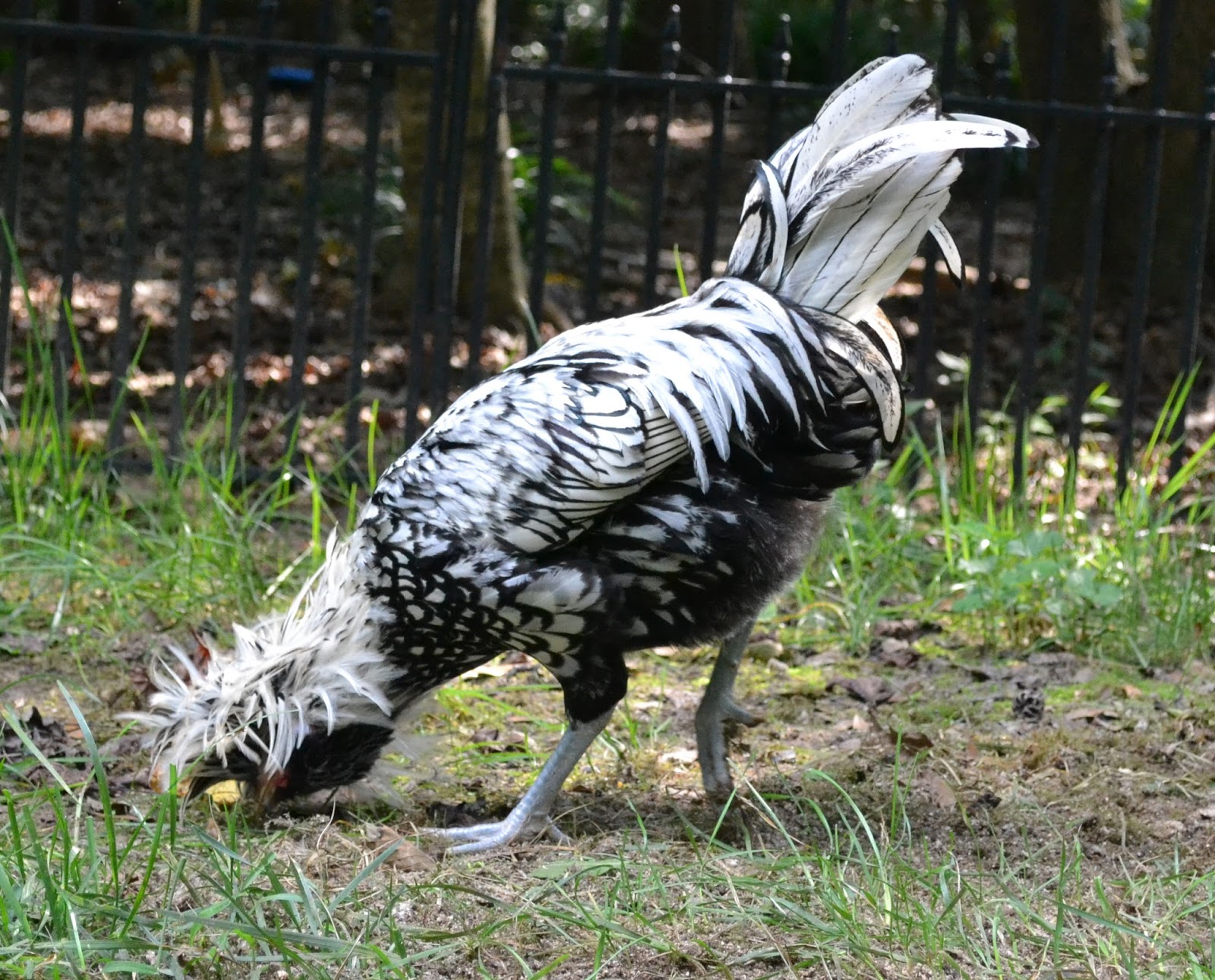
In May, we welcomed our latest chicks: Tinkerbell (Buff Laced Polish), Sprite (White Crested Blue Polish), Willow Wisp (Blue Andalusian), and Pixie (Silver Laced Polish).

Everything went well with the newest chicks. They grew, they thrived, the kids became smitten with their newest pets. 


Even integrating the new girls into the existing flock went fairly smoothly.

 And then, Pixie crowed.

Yes. Crowed.

Disaster.

When we began our chicken adventure, we knew the odds. Although we ordered pullets—female chicks—the hatcheries very carefully explain on their websites that sexing is not an exact science. In fact, there's a 10% chance that your order will contain a rooster.

10%.

One in ten.

Every year since our adventure began, I've warned the kids that if one of the chicks falls into that 10% error-margin, we cannot keep a rooster.

(For those of you just joining us: we live in a subdivision. On less than an acre. With a Homeowners' Association.)

Each year, we've held our breaths—and we've been lucky.

Until now.

“Third time's a charm” apparently didn't apply to our third flock of chicks.

Truthfully, we knew before Pixie announced it. While Polish possess an unmistakable “hairdo,” Pixie's plumage appeared significantly different than his sisters' feathers as he grew. Kristen suspected Pixie's “roo-ness” before he ever uttered his practice crow.

 
As I searched the Internet, images of young Polish roosters appeared that looked just like Pixie. When I cautioned the kids that Pixie would need to leave if and when he began to crow, they began researching ideas about how we could keep him. Kristen, my animal lover, even researched surgery for roosters to remove their crow. 

My sweet, animal crazy girl lost all reason.

She also plotted to paint his nails pink, put a bow in his feathers, keep him inside the coop so the neighbors wouldn't hear his crow, and basically LIE to anyone who asked if we owned a rooster.

I must admit, I actually thought of a few of those ideas, too.

But we parents must set aside our own emotions and help our kids make good decisions. We weren't going to subject Pixie to potentially fatal surgery, embarrassing hair-bows, or pink nail polish.

And we certainly weren't going to lie. (Tempting...but no.)

Instead, I reminded the kids that if we were inconsiderate neighbors, the entire flock could be at risk. Who knew what could happen if a neighbor complained? Instead of finding a new home for Pixie, we could potentially lose all of the girls.

The kids cried harder. 

It was a fine parenting moment.

So, when I heard Pixie's first crowing attempt, my chest tightened. The second attempt was also rather pitiful—but unmistakable.

The third time sounded almost like a real rooster.

It was time to make a plan.

Truthfully, it was past time to make a plan. The plan for Pixie's theoretical home should have been in place BEFORE we added chicks to our home. After all, we're not the only people who try to re-home a rooster. I remember reading Theresa's account of re-homing her rooster on her blog, Living Homegrown. I even sent her a sympathetic message, praying that we'd never be in the same boat. Silly me.

In the excitement and emotion of selecting chicks, most of us never really properly plan. Although Kristen read more than a dozen books about chickens, we attended a seminar about raising chickens, and I spoke with several farmer friends, we learned some things the hard way.

I hope you can benefit from our experiences.
 

12 Truths about Backyard Chickens

1. Tiny Chicks = Big Chickens.

Those cute little fluff balls at the feed and seed store will grow into large eating and pooping machines. Do you have the time and space to provide a good home for them? A Rubbermaid container in your house might hold chicks for awhile, but then what? Did you check with your Homeowners' Association, city, or neighbors to make certain chickens are allowed? Check your local ordinances before those cute fluff balls follow you home.

2. Cute Coops vs. Safe Chickens
The adorable coops you've pinned on Pinterest or that you plan to order online may be darling, but will they keep out predators? Our first precious little coop that I bought online was guaranteed “raccoon-proof.” And yet, a raccoon opened two sliding latches and killed Saltine. It was horrible. Granted, our chickens are pets, so we all took it very hard. Our new Chicken Fortress is like Fort Knox for chickens. Peter constructed it from scratch, and the door handle/lock requires two hands to open it by turning the latch down. We've yet to cute-ify it—it's not Pinterest worthy. Yet. But our girls are safe, and that's what matters.

3. Free-Range Fun. For Dogs. And Hawks.
Free-range is fine and dandy, and the neighborhood dogs will thank you for their mid-afternoon snack. Supervised free-ranging is a better idea. We let the girls free-range while we're working in the garden or swimming in the pool so that we can keep them safe. Speaking of gardens...

4. Gardening with Chickens = Hungry You.
Chickens will eat your garden. It's an urban legend that chickens and lettuce will coexist. I assure you, the minute we let the girls out into the forest to free-range, they head straight for the kitchen garden, while I fuss and yell and tell them to stop eating the chard. They don't listen to me. However, they do eat the bugs in your garden. They're also great mulch movers. If you let them play in your garden, I can assure you that they will do a fine job of removing all of the mulch surrounding your plants.

5. Chickens Are Not Penguins.

Chickens fly. Yes, I know you think they don't—but they do. Not all breeds are flighty. Silkies tend to be land lovers. But boy—do your research. Just ask our neighbors, who knocked on the door one Saturday morning to inform us that our two Golden Campines, Sugar and Spice, had joined their yard sale. Mortifying. By the way, clipping a wing does not necessarily cure flighty birds. We clipped one wing on each of our Campines, as recommended, but they quickly regained their balance and continued cruising the air. If you don't have an enclosed run, research the flightiness of the breeds you want to raise before your pick up your chicks. And install bird netting to keep them contained.

6. Picky Chickies.
Some breeds like warm climates, some prefer cool. Research, research, research, and then select which breeds are appropriate for your climate. Regardless, always watch the temperature to keep your flock healthy. Provide good shelter and insulation in the winter, and keep the girls cool in the summer.

7. Mission: Impossible.
Covert chickening keeping is impossible. If your HOA doesn't allow backyard chickens, please don't assume that you can sneakily raise them. Have you ever heard the proud announcement a chicken makes when she lays an egg? It's loud. While it's not as annoying as our neighbor's hound dog that brays for hours, it's an unmistakable sound. Plus, sometimes they like to cheer each other on as the egg laying progresses. Trust me. I've done the walk of shame to the school bus stop on many occasions, pretending that I don't hear our girls' raucous party. 

Oh. Ditto for covert roosters. Just don't try it. You'll get an ulcer.

8. Don't Quit Your Day Job.
You will not get rich selling eggs. And if you think that raising chickens will be an excellent lesson in entrepreneurship for your pre-teen daughter, just realize that she will never, ever approach anyone to ask if they'd like to buy eggs because she is too shy. (Just my experience.) Friends will offer to buy eggs, but usually you'll give them away to neighbors to keep the peace when chickens show up at their yard sales. There IS a good market for free-range, organic eggs, but will your 6 backyard hens provide enough eggs for you to sell at the Farmers' Market? No, they won't.

You will, however, enjoy delicious eggs with deep, orange-yellow yolks. Now, that's rich.

Also, you will most likely buy eggs in the winter. Or when your girls molt. Or when they get stressed. As daylight shortens, hens' egg laying slows—and even stops. Yes, you can provide supplemental light to make them continue laying, or you can let their bodies takes a much needed rest, as nature intended. Studies have shown that the supplemental light can decrease the number of years a hen lays.

9. How Organic Are Your Eggs?
We all want organic eggs, but organic chicken feed is tricky to find, plus it's pricey. Our local feed and seed doesn't carry organic feed, and I haven't found it anywhere in our area. A permaculture group I belong to is working to find a supplier, but until then, our girls get Layena, plus organic fruit, veggies, and free-range goodies. I'll always prefer our eggs over organic store-bought eggs any day, because I know we have happy, healthy hens.

10. There are no chicken-friendly hotels. (If you find one, please let me know.)
Leaving for a quick weekend get-away just got a little trickier. While it's pretty easy to ask a friend or pet sitting service to check in on your pooches, not many people are as enamored with chicken-sitting. Really, it's not difficult, it's just...different. If you find a friend who will watch your chickens, you've found a true friend. Make sure to bring your friend a present from your trip—and, of course, reward your chicken-sitter with some eggs.

11. Chicken Retirement.
Chickens typically lay well for about 3-5 years. Then what? What's your exit strategy? They can live another 5, 10, even 15 years. It's important to have a plan. Our girls will have their home here always, and when they stop laying—they'll live out their old age being our pampered pets, just as they are now. But what will you do? Will your chickens be pets, or will they become dinner? It's not easy to find homes for your non-laying chickens. There's no such thing as a chicken retirement home, so make certain you have an exit strategy.

12. Cock-a-doodle-do Party Crashers.

Roosters happen. What will you do? We were VERY lucky. A woman that works for Peter raises chickens on her land in the country, and she's just as crazy about them as Kristen. After checking into several issues (are there other roosters that might attack Pixie? Will he be inside at night? How safe is the coop?), we all agreed that Sandy's farm would be the perfect place for Pixie. Plus, lucky Pixie—he has 50 ladies to woo! Off he went to live with Sandy. The kids were thrilled, knowing that they could visit Pixie and get updates on him. I'm thrilled, because I can finally go outside again, without fear of being accosted by our neighbors. Peter is thrilled, because I've stopped stressing and obsessing about what we should do with a rooster. And apparently, Pixie is thrilled, because he's enamored with a black bantam lady-friend. Go, Pixie!

But we were lucky. Do you know a farmer? Have you asked that friend with land if he would be willing to take in a rooster, should you fall into the 10%? I can assure you, there aren't many people willing to take in a rooster. Kristen's horseback riding trainer laughed at me when I asked, then realized I was serious.

She suddenly found a stall to muck out.

So please, for your sanity, for your kids' emotional well-being, for the health and safety of your new fluffy babies--make a plan.

13. OK, It's a Baker's Dozen of Truths.
Even with the raccoons, the roosters, and the escape artists, chickens ARE fabulous. Our kids learn the responsibility of caring for their pets, rarely griping when they tend chickens before breakfast. With backyard chickens, you can cancel your cable, because there's nothing as entertaining on TV. We spend a lot of time amusing ourselves, laughing at our silly girls.
 
We love our chickens, and we thought we were well prepared. But raising chickens is a constant learning process. The chicken blogs, Facebook pages, and magazines sometimes sugar-coat the reality of chicken-owning. Cute coops, fluffy chicks, funny pictures, they're all lovely. And it IS fun.

Honestly.

But like with any living animal, you need to be prepared. 

You might just find yourself in the 10%.

Good luck!

XOXO ~

Julie