Monday, September 17, 2012

Preserving a Peck of Potent Peppers.

-->

It happens every year.

Enamored with names like 'Burmese Looking-to-the-Sky' and 'Chinese 5-Color,' I purchase too many seeds of too many varieties of hot peppers.

'Scotch Bonnet' and 'Fish Pepper'--really, how can I resist?

I can justify the purchases and the work in growing them—they're for my business, of course. But then I begin planting our family garden, and suddenly I'm squeezing pepper plants in every available extra bit of sunlight that I can find.

This year, 30 hot pepper plants consumed the garden.

Our abundance of hot peppers would make sense if we often cooked exotic, spicy meals. Occasionally, we try interesting recipes. But the reality of life with two younger children means that mealtime relies on tried-and-true basics. After all, it's enough work to cook dinner after running the kids to horseback riding lessons, soccer, chicken shows, or play dates. Preparing a hot-and-spicy meal that no one will eat isn't worth the effort.

Still, the peppers overrun the garden. Bags upon bags of hot peppers line the shelves in the refrigerator. Every time I walk to the back garden, I return with a shirt full of hot peppers.

Thankfully, college son and his girlfriend love hot peppers, so I always count on them to take a bag back to school. They even made hot sauce a few weeks ago.

While I haven't attempted hot sauce yet, I decided it's time to take charge of the plethora of peppers. After all, I can't stand wasting perfectly good produce, especially food that I've nurtured from seed. 

It's sacrilegious.

Plus, earlier this year, I set a goal to learn how to preserve food. Faced with my bounty, it was time to live up to my self-imposed challenge.

In case you, too, possess an overabundance of hot peppers, here are five ways to use your spicy loot:

First, PLEASE NOTE: Treat yourself to plastic gloves before you begin working with hot peppers. Trust me. There is nothing worse than cleaning and cutting hot peppers, then later removing your contacts. 

It. Is. Excruciating.

Also, handling lots of hot peppers, particularly the seeds and membranes, can burn your skin. Please, please—wear the gloves, even if you think they're dorky.

For all types of preparation, make sure to wash the peppers and dry them well prior to use.

Dehydrate
Drying peppers in the oven is simple—but quite honestly, it took a long time. An unexpectedly long time. Much, much longer than any instructions mentioned. And our house smelled rather...spicy, to put it nicely.

I used the setting on our oven for dehydrating. Honestly, you don't need a special setting. Set your oven to its lowest temperature. If you do not have a convection oven, leave the oven door slightly open to allow air circulation.

Arrange peppers in a single layer on a baking sheet. 

Initially, I began the process with whole peppers. However, because several varieties were not drying well due to thick flesh, I cut them in half to help aid drying.

Most recommendations I found suggested drying the peppers in the oven for 12 hours. After 12 hours, I halved the peppers. Still, I found that the peppers required another 24 hours in the oven.

Dehydrating peppers in the oven is extremely easy—but it definitely ties up your oven.

If you have a food dehydrator, a friend recommended setting up the dehydrator outside to avoid the noxious fumes that might make your children run away from home.
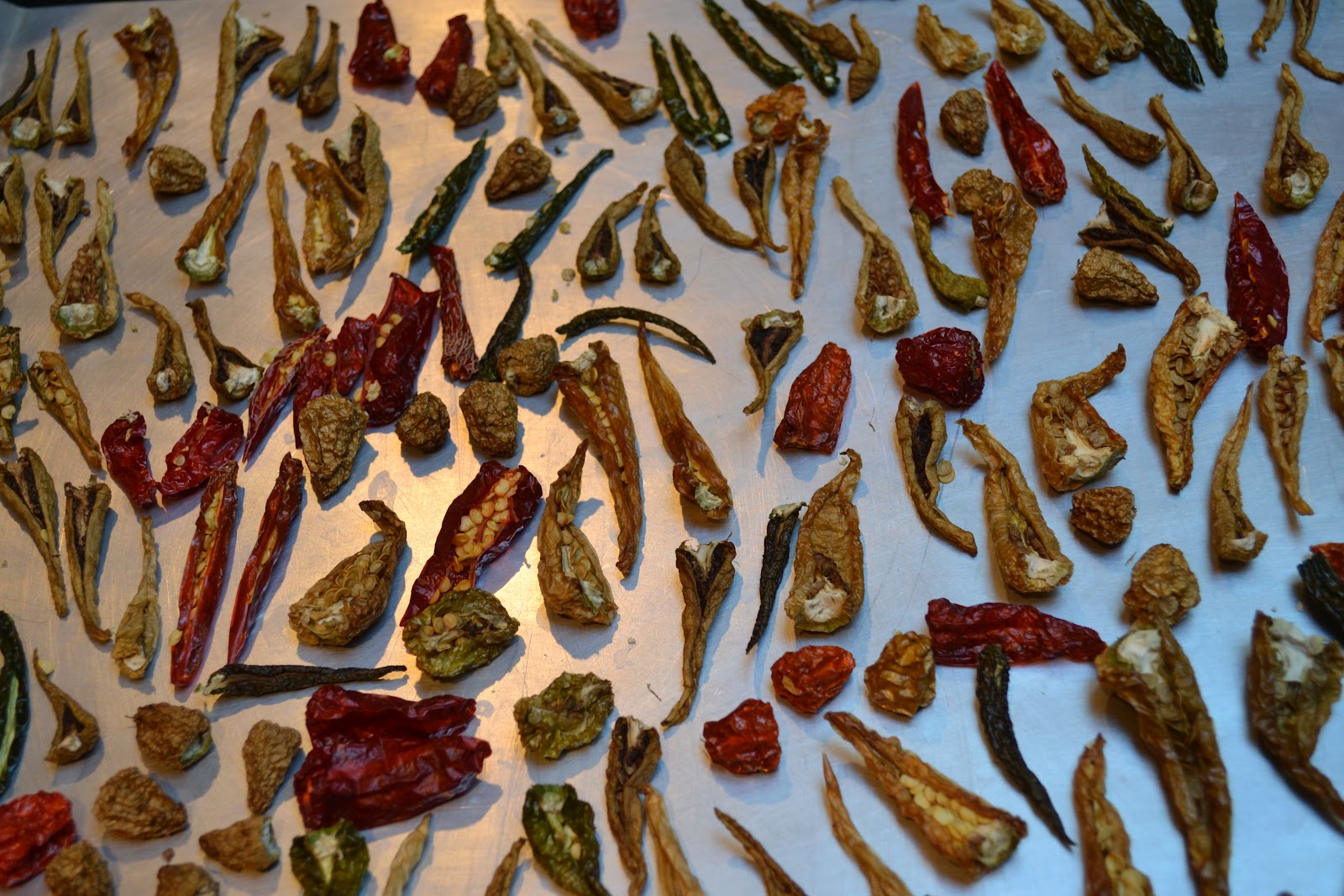
Once the peppers finish drying, let them cool. You can either store the dried peppers whole or crushed. Because I needed to save space, I chose to crush the peppers. Again, be careful with the process. 

I placed the dry, cool peppers in a Ziploc bag...

...then crushed the peppers using a rolling pin. (It's very therapeutic!) Even with the peppers contained in the bag, enough dust and fumes escaped to cause a pretty nasty coughing fit. You might consider wearing a mask.

While slightly hazardous, the end result looked good—a nice jar of pepper flakes, ready to use.

Canning
I'm not sure why I find canning so daunting. My first attempt at pickling peppers seems successful. I suppose the true test comes this winter, when we open the jar. Still, the process is simple.


From my newly purchased kitchen Bible, Ball Blue Book of Preserving:

Pickling Hot Peppers
(Yields about 5 pints)
Ingredients:
1-1/2 pounds banana peppers
1 pound jalapeƱo peppers
¼ pound serrano peppers
6 cups vinegar (I used white—cider vinegar can affect the color of the peppers)
2 cups water
3 cloves garlic, crushed

Leave peppers whole or cut into 1-inch pieces. Mix peppers together. Combine vinegar, water, and garlic in a large sauce pan. Bring mix to a boil, then reduce heat and simmer for 5 minutes. Remove garlic. Pack peppers into hot jars, leaving ¼ inch headspace. Ladle hot liquid over peppers, leaving ¼ inch headspace. Remove air bubbles. Adjust two piece cap and tighten on jar. Fill a large canner or stock pot with water. Heat water until boiling, and place jars into the pot, making sure the water covers the entire jar (including the lid). Process for 10 minutes. Remove and allow to cool.

Ball's food preserving website is a marvel—check it out for other great recipes.

Freezing
Honestly, if I possessed unlimited freezer space, freezing would be my choice of preservation. It's so simple. Wash peppers, dry peppers, put in freezer bag, remove excess air, label with date, and store. 


That's my kind of food preservation!

The drawback of freezing: lose your electricity, lose your food. For people looking for food security, freezing might not be the best option.

But it's so easy...

I'm torn. That's why I'm trying lots of options this year.

Air drying

I've always loved gorgeous ristras hanging in kitchens, with dried peppers within easy reach for use. The key to making a ristra is to use peppers that can dry easily. You don't want to use peppers with very thick flesh, as they tend to mold instead of dry.


To make a simple ristra, thread fishing line through a needle and make a large knot at the end of the line. Push the needle through the stem base of the pepper, stringing the pepper to the end of the line. Continue to add peppers, leaving enough space between peppers for good air circulation. When you have strung the peppers, tie off the line at the top. Hang the ristra to dry, which may take several months. 

Fresh
Of course, using the hot peppers fresh from the garden is ideal. Here's an amazing Thai dish for you to try from one of my favorite foodie blogs, Orangette.


Do you have a favorite recipe for using fresh hot peppers? If you do, would you please, PLEASE share it?

Because when I was in the garden yesterday, I found literally hundreds of hot peppers, waiting to be harvested.

Hundreds.

Next year, I promise—I will be strong and resist all of those intriguing chile names.

Two plants, maybe three. 

Four, tops.

(If you're in Upstate SC and need some hot peppers, come on over!)

Good luck with your peppers—I'd love to hear how you preserve your peppers.


Cheers!

XO ~

Julie

Saturday, September 15, 2012


Happy Garden Bloggers' Bloom Day, sponsored by May Dreams Gardens!
 
Today, along with my first foray into pickling peppers, caring for a sick boy, watching an Indiana Jones marathon with previously mentioned sick boy, peeling 25 lbs. of tomatoes, turning those tomatoes into sauce, and cheering on Chicken Mama as she participated in her first 4-H chicken showmanship competition, I wondered how I could participate in Bloom Day.  

Honestly, there's not much action in our gardens.

(Unless you count the incredible growth of weeds.)

So, I was surprised when I left sick Mikey, engulfed in a Pokemon Wii battle, to walk through the gardens for a few minutes.

I actually found a few blooms. Hooray!


Lantana is our garden workhorse, When all else is bare, lantana saves the day. Not only is it a hummingbird and butterfly magnet, it provides a nice splash of color late in the season when most of my perennials are tired. Done. Spent.


I know in many parts of the country, lantana is considered invasive. In our garden, however, I've never found a volunteer.
 

Found in the same bed as the lantana, Rozanne geranium makes a reappearance. During the intense heat of our South Carolina summer, this lovely little flower tends to disappear. Now, though, a nice blanket of blooms emerges.
 

Tall verbena add a bit of height to the front perennial bed...


...and although 'Gin' begonia claims to be an annual, it reappears every year along the front walk. (That's the kind of false advertising I like!)


Thank goodness for Japanese anemone. Without it, our front flower beds would be bare. Originally five plants, the entire driveway bed is now a mass of pink blooms. 


I believe it's time to transplant and share the anemone love along the side of the garage.


Snail flower is one of my favorite vines. Originally started from seed in our greenhouse, the enormous vine produces gorgeous corkscrew flowers in late summer. 
 

The seeds are pricey--$1 per seed. 

It's worth it.


Gaura, or whirling butterflies, tend to slow down mid-summer. In fact, two gaura plants completely gave up this summer. This one appears to be a volunteer.

  
Ah, butterfly bush--I think you're embroiled in a scandal. Personally, I love how you attract pollinators. Still, other gardeners find your lack of native appeal and invasiveness... unappealing.


Be still, my heart--is that a rose??? In our shady garden? Why yes, it is! I'm always shocked to find a rose in bloom.
 

'PeeGee' hydrangea is one of the few hydrangeas that continues to put on a show.


The fraise des bois, however, are flowering and fruiting madly--and sweeter than ever.


Native hibiscus tends to be showy in late summer...if you can keep the caterpillars away.


Oreo is a fantastic gardener. I'm pretty certain she plans to remove that nasty grass from the flower bed--with her back paws. 

Lazy cat.


Surprisingly, the phlox performed well this year. Typically, I battle powdery mildew on the phlox, but this year the phlox was untouched. Hooray for small miracles!


Mint in the herb garden, beginning to flower.


The blooms of fennel attract many pollinators, while the plant serves as a host for several butterfly species' larva. 


The cucumbers, watermelons, and peppers continue to produce in the large vegetable garden.


And the wildflowers continue to adorn the vegetable garden by the river.


One of my favorite vines that I overwinter in the greenhouse is mandevilla. I love the tropical flavor it adds by the pool.
 

 Lamium continues to share it's shell pink blooms...


And the azaleas' repeat blooms are in full swing.


Dragon Wing begonia, sporting a long-legged friend.


A few strawberry plants are producing autumn fruit. 


And finally, Black-Eyed Susan vine adds a nice splash of color to our dreary backyard. (I also propagated the vine from seed.)

So, apparently we do have a few blooms remaining in our gardens. Now, if only I would find a few more hours in the day so that I could venture outside more often to stop and smell the flowers--literally.

Happy Bloom Day to you!

Cheers!

Julie

Wednesday, September 12, 2012

The Unexpected Visitor.


It's 9:45 a.m.. Guess who is still in her pajamas?

I'm not sick. I'm not taking a mental health day. And I've even entertained a visitor  this morning. I've been too busy to shower.

You see, I've spent the last two hours watching a hummingbird. 


Inside. 


With gorgeous, fall-like temperatures this morning, I left the balcony door wide open to air out the house. And, as you know if you visit here often, our just-filled hummingbird feeders draw a lot of visitors.

One of our guests took an unfortunate detour.

Reading important news at my desk, as I do every morning as soon as the kids head to school, I heard an odd sound from the living room. My first thought was: “Bad dog!” It sounded like something being shredded. I ran in the living room, looking for Chloe who, while extremely finicky about eating her dog food, will sneak people food at any opportunity. (Usually Sophie is blamed, but she just eats everything shamelessly. Chloe is sly.)

I didn't notice that both pups hadn't moved from their beds. In the office.

Then, I looked up.


When we renovated the house last year, skylights seemed like a great idea.

Today, I cursed them.

Normally, if a bird flies into a house, the easiest way to remove it is to open a door or window, make the rest of the house dark, and let it naturally fly toward the light.

Of course, that's not possible when you have windows on the ceiling that don't open.


I thought about closing the shades on the skylights, but because the shades close via remote control—and the hummingbird used the channel as a perch—I feared injuring the bird or trapping it under the shade.


Plan B.

In a burst of creativity, I went outside (yes, in my PJs), grabbed a hummingbird feeder, came inside, and attached it to the handle of a broom. I stood on the couch, holding the broom/feeder over my head, waiting for the hummingbird to land on the feeder. It was, after all, becoming exhausted.

And then I spilled sugar water all over the couch, the floor, the coffee table...and me.

Note to self: couch cushions are not very stable.

Plan C.

Now, instead of the couch, I climbed a step stool and held the broom/feeder concoction. And spilled more sugar water.

Still, the hummingbird ignored it.

Plan D.

So, deciding the broom/feeder combination might be stressing out the poor bird instead of helping, I tried a more natural approach.

I cut two long branches of lantana, tied them to the broom handle, and held it up to the skylight.


I mean, seriously—those birds can't get enough of the lantana outside the office window. Surely, the hummingbird would land on a branch to drink some nectar—it was really getting tired now.

(Can you envision it? Me. The top step of the ladder. Pajamas. A broom disguised as a lantana bush. I'm grateful no one was home to take a picture.)

The lantana truly was inspired, don't you think? The bird obviously didn't appreciate my creative genius. It continued to whack its tiny body into the glass.

Plan E.

Kids' fishing net.

Thankfully, the handle on the net was too short, even with standing on the top step of the ladder. I'm glad, too, because I'm afraid the net might have damaged the hummingbird's wings.

Plan F.

Call Peter.

Argh. I hate when I can't solve something like a hummingbird trapped in the house by myself! Still, Peter is about seven inches taller than me, and I worried that the bird wouldn't make it much longer if it didn't get out. I left the room, hoping it might fly lower without me near, and waited for Peter to come home from work. (Thankfully, the company is ten minutes away.)

Of course, I couldn't stand it.

I peaked in the living room—and there it was, flying just above the picture on the wall. Then it perched on the frame. YES! I tried to sneak up on it, thinking to catch it in my hands—and then it zipped past my head, into the kitchen, where it promptly flew into the wall and fell onto the bench.

Oh no.

But when I looked closer, it was alive. Exhausted, but breathing.

I opened all of the kitchen windows, but then thought—if I catch it and release it from the kitchen, which is very high off the ground—the bird might not be able to fly. So, in my infinite wisdom, I decided to get the hummingbird feeder, put it on the balcony, catch the bird and place it on the feeder.

Of course, while I thought all of this, the hummingbird recovered from its bang into the wall, flew over my head...and behind the refrigerator.

Sometimes, it doesn't pay to think.

Fortunately, Peter walked in five minutes later.

I was afraid what we'd find behind the refrigerator. 


And there sat the hummingbird, covered in dust bunnies. (You're judging my housekeeping skills now, aren't you?!)

Peter carried the little fuss-budget to the balcony. It sat for a moment on his hand, and he tried to move it to the feeder.


Instead, without so much as a peep, it took off and flew to a high branch in the tree.

(Blurred by my excitement...)
 
We put the feeder back in its place, closed the balcony door, and waited to see if the hummingbird would venture down for a drink.

No luck. Yet.

So, that's how I've spent my morning. I think it's now time for me to take a shower, get dressed, and perhaps try to get a few things done.

Like mopping up the sugar water on the living room floor.

After that, I might just hang out on the couch and spy on hummingbirds.

Note to self: always close the balcony door.

Cheers!

Julie