It began with an apple.
Years ago, when our oldest son, Tyler, was nine years old, we invited one of his neighborhood friends to join us on our annual apple orchard outing. Will is two years younger than Ty, and it just breaks my heart when I see this tall, muscular GUY next door shooting baskets. He's the youngest of Ty's neighborhood gang and always fought to keep up with the older boys. Soon he, too, will be off to college.
Sorry. A sentimental Mom-moment distracted me.
Anyway, we were out among the trees, and Peter picked a few apples. He handed one to each boy, then took a bite of his.
Will looked appalled.
“You can't do that,” he said, horrified.
“Don't worry, honey, we'll pay for everything when we get back.” What an honest boy, I thought.
“No,” he said, eyes wide. “You can't eat that.”
“Why not?”
Will looked at me like I was from another planet.
“It's not from Publix.”
~ ~ ~ ~ ~ ~ ~ ~ ~ ~ ~ ~ ~ ~
It's fall, and I'm thinking about apples. And remembering Will's innocence.
I'm also hoping that our kids always know the origins of their food, whether or not they actually eat it. (That would be asking too much, with the exception of apples. Oh, and strawberries.)
With the arrival of fall, I know I'm not alone in my apple preoccupation. My Facebook page is filled with pictures of friends' families hunting Granny Smiths, Golden Delicious, Jonagolds.
This year, we branched out and tried a different orchard, one in North Carolina. Normally, we visit a local orchard that's ten minues from our house—but truthfully, we've always gone for the experience rather than the apples. The apples at our local orchard are tasteless, even a little mealy. This year, I wanted a good variety of flavorful apples, even if it meant forsaking our (very) local orchard.
I'm glad we did.
Sky Top Orchard is exactly that—a lush, rolling, mountain-top orchard with stunning views. Located in Flat Rock, North Carolina, we visited early in the season, but the parking area was packed. With 40 acres to roam, though, the only places we really bumped into other visitors (besides the parking lot) was in the apple cider donut line.
Can you believe that I never tasted an apple cider donut before this fall? It's was pure sugar and grease and deliciousness. Heaven.
I'm not an apple expert. I've gone apple picking every year for probably the past 18 years...and I still don't remember which varieties are tart (besides Granny Smith), which are good for cooking, which are best fresh. During our apple hunting, I was certain Peter searched for a variety of apple that didn't exist (“Jonathan” versus “Jonagold”—the one I was familiar with). I started to tell him in my know-it-all wife voice that his search was futile...until we found his variety already pre-picked.
I just hate when he's right.
After a lovely family outing, I decided it was time to increase my knowledge of apple varieties. I started doing some research and found a great article on Saveur. It's my go-to guide now.
Do we honestly think I stopped there?
I'm now completely smitten with heirloom apples.
(Poor Peter, I haven't told him about my newest obsession. He'll be reading it here.)
“Jonathan” is an heirloom variety. In fact, it's among the 129 varieties listed in Slow Food USA's Ark of Taste.
Do you know about the Ark of Taste? Here's a quote from Slow Food's website:
“The Ark is an international catalog of foods that are threatened by industrial standardization, the regulations of large-scale distribution and environmental damage. In an effort to cultivate consumer demand—key to agricultural conservation—only the best tasting endangered foods make it onto the Ark.
“Since 1996, more than 800 products from over 50 countries have been added to the international Ark of Taste. The US Ark of Taste profiles over 200 rare regional foods, and is a tool that helps farmers, ranchers, fishers, chefs, retail grocers, educators and consumers celebrate our country's diverse biological, cultural and culinary heritage.”
The apple is an American icon. However, of the approximate 14,000 varieties that evolved from the seeds brought into North America by English settlers, today only 11 varieties comprise 90 percent of all apples consumed in the U.S. Those 11 varieties that dominate the produce aisles are grown in large commercial orchards, easily packed and shipped to far away locales. The perfect, glossy globes attract consumers—but flavor is sacrificed for shipablility and presentation.
One of the goals of Slow Food is to make consumers aware of varieties that are dying out due to mass production. It's Economics 101. By experiencing the unique, richer flavor of heirloom varieties, consumers will begin requesting heirlooms, and farmers will find a market to continue producing tasty, regional fruits. Sounds simplistic, doesn't it?
Of course, it's a much larger challenge.
So, in my own small effort to support heirloom varieties, I'm researching nurseries and varieties and figuring out how to tell Peter that we need a small orchard near the river.
I'm sure he'll be delighted. Stay tuned...
Until then, I'm taking an inventory of the apples waiting in the refrigerator. Not only did we bring home dozens of apples from our family's Sky Top outing, Michael and I also brought home apples from his kindergarten field trip.
It was a little sad. The kids picked apples—out of bins. So now, there's a generation of kids who think apples come from bins on farms. Hmm. Somehow, I don't think that was the point of the field trip.
Still, we are—literally—bursting with apples.
Fortunately, my family likes apples. They especially like apple desserts. Rather than my standard apple pie, I decided to try something new. I found a recipe on the blog, Orangette, for an excellent “Apple Tart Cake.” The author of the blog, Molly Wizenberg, stated that the tart is even better the second day. She's right. If you've never visited Orangette, please do. You'll be delighted.
So, before I get back to researching which heirloom apple trees would best fit my family's needs—some for eating fresh, some for cooking—I'm heading to the kitchen to make another Apple Tart Cake. You really want to try this recipe—it's easy, delicious, uses pantry staples, and has a rustic appeal. (My cake is not as pretty as the one on the Orangette blog, but it was tasty.)
You can use any variety of good, tart apples. What are your favorite varieties for cooking or fresh eating? I'd love to know.
So, head to the kitchen, pull out those apples from your orchard visit, and start peeling. You'll be so glad you did.
Apple Tart Cake
Adapted from Orangette, originally posted January 19, 2009
Ingredients:
1 cup granulated sugar
1 cup all-purpose flour
1 tsp. baking powder
5 Tbsp. cold unsalted butter, cut into a few pieces
1 tsp. vanilla extract
1 large egg, lightly beaten
3 large Granny Smith apples, peeled, cored, and sliced very thinly
For topping:
3 Tbsp. granulated sugar
3 Tbsp. unsalted butter, melted and cooled slightly
1 tsp. ground cinnamon
1 large egg
Preheat oven to 350°. Butter and flour a 9-inch springform pan.
Combine the sugar, flour, and baking powder in a bowl. (I used my KitchenAid mixer, which worked fine, but the original recipe calls for use of a food processor.) Add the butter. Mix until no large lumps remain. Add the vanilla and the egg. Blend well. Mixture will be crumbly. Dump mixture into the prepared springform pan, using your fingers to gently press it along the bottom of the pan. If the dough sticks to your fingers, like it did with mine, just put a tad of flour on your fingertips. Make a slight, gentle, upward curve at the edges to form a low rim. Arrange the apple slices over the base in a tight circular pattern. Really overlap them. I didn't overlap the apples the first time I made it for fear they wouldn't cook well. My mistake. Place the pan on the middle rack in the oven, and bake for 45 minutes.
While the cake/tart is baking, prepare the topping. Combine the ingredients in a small bowl, and whisk to blend well. After the cake has baked for 45 minutes, remove it from the oven, and pour the topping evenly over it. Bake for another 25 minutes or so, until the topping looks set. Transfer the pan to a wire rack, and cool for 20 minutes. Then run a thin knife around the edge to release any areas that may have stuck, and remove the sides of the pan. Cool completely before serving.
Enjoy!
Tuesday, October 19, 2010
Tuesday, October 12, 2010
Christmas in October.
It's October, but it feels like Christmas.
Look what arrived.
Nope. It's not the kids' Halloween costumes. That was a different box.
These are my treats.
Garlic.
Specifically, it's my “seed garlic.”
I'm ridiculously excited!
I know what you're thinking. “Garlic? You can buy garlic at Publix. Bi-Lo. All grocery stores sell garlic.”
True. But until you grow your own garlic...you've never really tasted garlic.
Last year was my inaugural attempt to grow this pantry staple. I mean, honestly—I usually pay 99 cents for a three-pack of basic, white garlic bulbs. It seemed a waste of time and effort to cultivate my own organic garlic.
But you know my gardening obsession. I had to try it.
Oh. It was so worth it.
I know you're skeptical, and I understand. Truly. Though garlic dates back thousands of years, cures 22 ailments, according to an Egyptian papyrus dating from 1500 B.C., and was found in King Tut's tomb, garlic was shunned in America until the twentieth century, due to its pungent, lingering aroma. In 17th century England, it was known that garlic was “...not for ladies, nor for those gentlemen who wanted to court them.”
It's a good thing that Peter and I both like garlic.
Many herbalists believe garlic can cure the common cold, fight high cholesterol, serve as a natural antibiotic, and even repel mosquitos.
Plus, we all know the mythology involved with garlic—vampires, be gone.
(Well, unless you look like Edward Cullen.)
Garlic, and its culinary uses, arrived with the influx of immigrants into the United States. It wasn't until our new citizens arrived that garlic became a common, well-loved fixture in the kitchen, permeating the American culture with its flavor...and scent.
I'm so glad it did.
Honestly, could you imagine Shrimp Scampi without garlic?
The beauty of garlic is that it's incredibly easy to grow. I promise. In the fall, when your garden looks tired, and you're pulling up the last of your gangly tomato plants, you can keep your garden productive with very little effort. It's also a great crop to grow if you've never gardened. You dig a hole, place a clove in the hole, cover it up, add some mulch on top, water occasionally during dry spells, and viola! By June, you'll be harvesting fresh, flavorful garlic that is so much better than the grocery store variety.
Speaking of varieties...do you know how many kinds of garlic are available?
Neither did I. But I do now...
First, there are a couple distinctions. Softneck garlics, which can be known as Artichoke, Italian, or Silverskin, are the most commonly grown garlics in the world. These are the garlics that you traditionally see braided and hanging in rustic farmhouse kitchens. Orphio, or hardneck garlic, derives from wild garlic. Orphio forms a circle of cloves around a single, woody stalk, while softneck varieties form cloves in a spiral layer. Hardneck varieties traditionally perform better in cold climates.
Then, there's elephant garlic. Just to confuse things further--it's not a true garlic but a type of leek, with a mild flavor.
Who knew? I'm overwhelmed with options.
So, as is my habit when I can't make a garden-related decision, I bought a little bit of a lot. Here's what's awaiting planting:
Softneck:
Italian Braiding
Inchellium Red
Bianco Piacentina (white)
Viola Francese (purple/white)
Hardneck:
Music
German Extra Hardy (purple striped)
Rosso di Sulmona (red)
Elephant Garlic
OK. Maybe it wasn't such a little bit. Peter rolled his eyes when he saw the boxes.
Among some of my gardening friends, I've heard that seed garlic is selling out quickly this year. So, if you want to try growing your own garlic, here are two sources I use:
http://growitalian.com
http://southernexposure.com
Now, the fun begins!
Prep the garlic.
Prepping the garlic is very easy but a little messy. You're simply separating (or “popping”) the cloves. Each clove will grow into an individual bulb. If you are OCD about your varieties, like I am, only prep one variety at a time so they don't get mixed. I like to separate the cloves over a big bowl to catch the papery skins, then put the cloves for each variety in a labelled paper bag. DON'T PEEL THE CLOVES. If some of the skin comes off, you can still plant the clove—but it can bruise easily, so handle gently.
I considered farming out this task to the kids...until my thumbs started hurting after the second bag of garlic. I turned on some mindless TV and continued popping the cloves.
By the way...do you ever find yourself watching kid TV when there are no kids in the room? I'm a little disturbed by this new habit of mine.
Although “Phineas and Ferb” is brilliant, you have to admit.
Prepare the bed.
A raised bed for garlic is great—but honestly, I just plant it in my larger kitchen garden, which doesn't have raised beds. I like to keep the rows about three feet wide so that it's easy to plant and harvest without stepping in the bed and compacting the soil. Add organic matter, like well-composted horse manure, and make certain the soil is well tilled. In South Carolina, I use a lot of compost to prepare our soil for planting—red clay is my nemesis.
Plant.
Within a day or two of popping the cloves, you'll want to get them in the soil. For best production, garlic needs to be planted in the fall to give it enough time to make sizable bulbs.
It's mid-October, so for me, that's my cue to plant garlic and pansies. Seeds from Italy recommends that northerners plant garlic after the first frost but 20-30 days before the ground freezes so that the garlic clove can begin to make roots. All garlic needs a period below 40 degrees to make bulbs.
I'm planting a lot of garlic, so my method of choice is to dig long trenches, about three inches deep, placing one clove of garlic root-side down approximately every six inches. In each bed, though, I'm going to plant several rows of garlic, staggering the placement of the cloves to provide ample growing room. Cover with soil and water well.
Oreo thinks it's really amusing to jump on my lap while I'm trying to work. Ignoring her isn't an option--she'll start kneading my leg with her claws if I don't fawn over her. Between kids and animals, it's amazing I ever get any work done.
Mulch.
After planting, it's important to add three to six inches of mulch to your bed. Shredded leaves and dry grass clippings are free and work wonderfully. I'm using straw, only because I have other plans for my leaves, which involves making a new front garden bed...but that's a different story for another day...
Mulch serves various purposes, depending on your climate. In the north, mulch will keep the ground moist and warm throughout the fall. In the south, it keeps the soil moist and cool. The mulch helps protect the garlic by minimizing the freezing and thawing that occurs in unprotected gardens, which can damage the garlic. Mulch also minimizes weeds.
And truly...who likes pulling weeds?
Well, OK. I do. On bad days when I'm annoyed, I kind of like yanking those nasty weeds out.
It's cheaper than therapy.
Winter.
Hibernate. Read recipes for garlic-laden Italian dishes and dream of scrumptious summer dinners. If you're having a really dry winter, make sure to water the garlic bed occasionally.
Spring.
In early spring, look for little shoots peeking through the mulch. As the shoots emerge and the weather warms, remove the mulch from the bed. Water during dry periods, and let the garlic continue to grow. For hardneck varieties, you will see the main shoot curl as it grows. These are known as scapes. Cut them off to make bigger bulbs, but don't throw them away—they are delicious braised in a bit of olive oil.
Harvest.
When the lower leaves of the garlic plant begin to turn brown, it's time to harvest—which is typically in June in mild climates, July in colder areas. Carefully dig up the garlic bulbs, leaving the stalks attached, and store in a well-vented location for several weeks to allow the garlic to cure. Do not put the bulbs in direct sunlight.
Store.
After curing, remove the stem (unless you plan to braid the garlic) and the outer papery layer of skin to ensure clean bulbs. Really, those garlic braids look so much better when there's not red clay attached to the bulbs. Store in a cool, dry location—and save a few of your largest bulbs for next year's planting!
And there, my friends, you have it. A plethora of pungent, flavorful garlic, plus enough left over so that you won't need to purchase starter garlic again.
Isn't garlic grand?
Just remember...make sure you share the wealth with your significant other...because eating garlic alone can make for a very lonely night.
Why don't you make this super easy, looks-way-more-fancy-than-it-is dinner for your honeypot tonight? (Honeypot is my new favorite word.) It's my go-to dinner, based on a recipe from my dad (who used the term "honeypot" in a letter to my mom) when I need a super quick meal that feels special.
Shrimp Scampi
1 lb. jumbo shrimp, peeled and deveined
½ cup unsalted butter (1 stick)
5-6 medium cloves garlic, pressed
1 tbsp. sea salt
1 cup white wine
Preheat oven to 450 degrees.
Clean shrimp and pat dry. Arrange shrimp in a single layer in a casserole dish. Do not let them overlap.
In a small saucepan, melt butter. Add garlic, sea salt, and wine, stirring until warm. Remove from heat, and pour butter mixture over the shrimp in the casserole dish. Place dish in oven, and bake for 5-7 minutes, or until all shrimp is thoroughly cooked. DO NOT OVERCOOK or shrimp will be tough.
Serve shrimp and garlic butter sauce over pasta, with a light grating of parmesan cheese on top.
Serves two very hungry adults, one 9-year-old who will eat three shrimp, and one 5-year-old, who will eat only plain pasta with cheese.
Or serves four adults with normal appetites.
Mint, anyone?
Tuesday, October 5, 2010
Tales from an organic farm...
I blame Laura Ingalls Wilder. From second through fifth grade, I was obsessed with Little House on the Prairie. Seriously obsessed. I read the book series at least a dozen times. I waited for Michael Landon and Melissa Gilbert to appear on TV each week, Pa crying dramatically while Half-Pint saved the family farm and outwitted resident meanie, Nellie Oleson. I wore a dress and bonnet, created by my amazing Aunt Georgianna, who lived on a farm. Every summer, I'd visit her for two weeks. We shared a June 16 birthday.
Still—life happened. I grew up, discovered boys, went to college, and didn't think twice about farming. I worked in publishing, then PR and advertising, only getting my hands dirty when I planted some pansies on the weekend. Who knew that one day my Laura Ingalls obsession would resurface, and I'd make my living from seeds and soil? When I was taking authors to wine-laden dinners and staying at the Ritz-Carlton, I never dreamed I'd be digging in dirt.
So, I was surprised when I received a note from a distant family member recently, commenting on my business:
“I wanted to tell you how impressed I was to hear of your entrepreneurial endeavors. Your choice didn't totally surprise me---I still remember the influence of Laura Ingalls in your young life---even down to your wardrobe!”
--Cousin Brenda
Well. I wish I had gone to Brenda for career counseling a long time ago.
Anyway...
When the opportunity arose to spend a day working on an organic farm, I jumped at the chance. What a fabulous way to bond with my daughter! What an amazing learning experience! Her first question:
“Will there be animals there?”
I told her, quite honestly, that I had no idea. I imagined there might be some chickens, but I couldn't promise her a barnyard filled with animals. Our purpose was to work on the farm, learn more about organic growing, eat an organic lunch, and help as needed.
Although a little worried about the organic, vegetarian lunch, Kristen agreed to go for the slight chance she might meet some new animal buddies.
Here's the thing about my girl: she loves nature. She loves animals.
She did not love Little House on the Prairie.
My saddest mothering moment occurred when I presented her with the series...and the books languished in her room. I mean—this girl is a reader. She flies through 700-page action-adventure books in a day or two. But poor Laura Ingalls Wilder...she was relegated to the bottom of the towering pile of to-be-read books, outranked by Harry Potter and The Guardians of Ga'Hoole. And, when Kristen finally read the most famous book of the series, instead of finding her in a blissed-out state of imagination, dreaming of bonnets and blind sisters, she blasely said, “It was alright.”
Alright?
Who was this alien child? Was she switched at birth?
I suppose this should have been a heads-up about our mother/daughter farm-day experience.
Organized by Greenville Organic Foods Organization (GOFO), a fantastic organization dedicated to promoting healthy growing and eating in the Upstate, the work day at Bio-Way Farm served as an opportunity for foodies, greenies, and wanna-be farmers to learn more about organic growing practices--while benefiting our host farmer with some free labor.
And we did labor. Whew.
GOFO organized the outing to Bio-Way Farm as part of its mission to educate the public about the benefits of eating organic foods, while raising awareness of sustainable agriculture and environmental conservation. To achieve these lofty goals, the Executive Director and founder, Viviane Trama, provides numerous outreach programs, such as the Grow Healthy Kids initiative, which organizes and supports organic school gardens, as well as educational opportunities to learn first-hand about the benefits of organic practices through “farm days.”
Located in Laurens County, South Carolina, Bio-Way Farm is a 120-acre certified organic farm that embraces permaculture principles--designing ecological human habitats and food production systems. Permaculture started with the belief that for people to feed themselves sustainably, we need to move away from reliance on industrialized agriculture, which is powered by fossil fuels and promotes monocultures of crops. Instead, permaculture stresses the value of working with the Earth in mutually beneficial relationships. For instance, rather than clear an overgrown field with traditional gas-powered machinery, install a herd of goats who will eat the brush and foliage, while also fertilizing the ground for future crops. Agriculturalists traditionally exploit soil, plants and animals, which leads to diseases, soil erosion, pollution from fertilizers, and even illnesses from factory farms, as witnessed in our recent egg recall. Permaculturalists practice agriculture by looking forward, maintaining the health of the land—and our food systems.
Apparently, I'm not the only person excited about sustainability. When Kristen and I arrived at the farm, there was already quite a crowd...19 in all. Kristen was the youngest, but there were two teenagers attending to earn school credit—but I'm pretty confident they had a good time regardless of why they signed up.
Viviane greeted our crew, outlining the day's events and introducing Chris Sermons, our host at Bio-Way Farms. Chris, his father and step-mother founded Bio-Way, planting 2000 asparagus crowns in 2004. In addition to fields of asparagus, they grow many varieties of seasonal produce, as well as fruit and berry crops. With 20 acres devoted to growing produce, the family strives to preserve biodiversity within its 100 acres of hardwood forest. They work to control exotic invasive plants while reintroducing native plants, which helps to restore wildlife habitats.
Surprisingly, the farm is worked by Chris. Just Chris. And occasional volunteers. And sometimes, friends. Twenty acres, one full-time farmer.
I'm exhausted just thinking about it.
But their asparagus? Oh. My. Next spring, you definitely want to find them at the Greenville Farmer's Market or through Upstate Locally Grown. Even my kids ate their asparagus when I bought it last spring...without too many bad faces.
(OK. I lied. They made bad faces. But they complain about every vegetable I put in front of them. If anyone can tell me how to change this annoying phenomena, please let me know.)
Our goal for the farm day was to learn about sustainable growing while helping Chris get some work done. Win-win.
We were down to 18 workers. Kristen took off with the dog after about 15 minutes. No chickens, but the dog would do.
So much for my dreams of working the land with my girl.
Instead, I met an amazing assortment of farm hands: a retired dairy farmer married to a city girl; greenies who wanted to learn more about gardening; a young woman whose progressive employer has an organic garden for its employees; an herbalist with an adorable vegetarian son; a young man who thought farming might be his calling (but, quite honestly, I think he changed his mind after he realized the amount of work); and lovely, pleasant people just interested in better understanding sustainability.
After an attempt to divide us into work groups, which quickly dissipated into chaos, we headed to the field. Our tasks:
weeding...
preparing beds for seeding...
transplanting cool weather crops...
ditch digging (guess who did this?)...
building a compost bed...
and harvesting.
Have you ever seen a Jerusalem artichoke? Stay tuned for a recipe using these funky tubers.
I can honestly say that working in a field with strangers makes you instant friends. (Except for the farmer wanna-be who was still raking the same three feet of earth after I had dug an entire trench down the field. Really, he needs to rethink his career path.)
After rounding up my girl from the swing, we cleaned up a bit and headed inside for a gourmet organic lunch, prepared by Chef Heather Kalka.
Oh. My.
Have you noticed that I'm fixated with food recently? Maybe it's because we're in the midst of harvest season. Or maybe it's because there's just so much good food and I have no willpower.
Anyway, I'm not a vegetarian, but if I had Chef Heather to cook for me—I could be. Amazingly delicious, healthy treats—delicious eggplant spread, scrumptious gnocchi, adorable blueberry tarts...mmmm.
Kristen ate--
bread.
Yes. Just bread. And water.
It was a jailbird diet.
Yeesh.
After lunch, Kristen disappeared with the dog—and newly found cat—while we toured the farm. Chris showed us the acres of asparagus, a recently constructed greenhouse, the irrigation system, and my favorite—his experimental woodland garden.
The woodland garden was fascinating, particularly since our property is forested. Kiwis, blueberries, pawpaws, herbs...it was amazing to see what Chris grows in the forest, with only dappled sunlight.
My next venture? Mushrooms. And blueberry bushes throughout our forest.
As Chris wrapped up the tour in the area devoted to a native plants nursery, I heard a strange squeak and saw Kristen racing toward the black cat, Rosemary. As we watched, my darling daughter pried a baby field mouse out of the cat's mouth.
The rest of my farmer buddies now understood I was telling the truth about my daughter.
And her animal obsession.
Well, perhaps she's not going to be a farmer.
But maybe she's more like Half-Pint than I thought.
Sunchoke Gratin
Ingredients:
* 1 pound sunchokes (Jerusalem artichokes)
* Salt
* An oven-to-table baking dish
* Butter for smearing and dotting the baking dish
* Black pepper, ground fresh from the mill
* 1/4 cup freshly grated Parmigiano-Reggiano cheese
Preparation:
Preheat the oven to 400 degrees Fahrenheit.
Peel the sunchokes and drop them in salted, boiling water. Cook until tender. Drain and cool. Cut into 1/2-inch slices.
Smear the bottom of a baking dish with butter, then place the sunchoke slices in it, arranging them so they overlap slightly. Sprinkle with salt, pepper, and the grated Parmesan, dot with butter and place the dish on the uppermost rack of the preheated oven. Bake until a light golden crust begins to form on top. Allow to settle for a few minutes out of the oven before serving.
Yield: 4 servings
Tuesday, September 28, 2010
Outstanding in the Barn.
Remember last week, when I wrote about my crazy issues with expectations? Well, after attending the amazing dinner produced by Outstanding in the Field at East Fork Farm, I assumed that no local farm-to-table event could possibly compare to Chef Dissen's delicious meal.
I was wrong.
Take one noble organization: Hub City Farmers' Market. Add 14 local producers, seven prestigious chefs, a wine expert, a dozen volunteers, a lovely location with delightful hosts, and you have the recipe for a fabulous evening.
The first annual Farm Dinner organized by Hub City Farmers' Market is proof that commitment to a cause inspires excellence. Hub City Farmers' Market is a not-for-profit organization, unlike Outstanding in the Field. The proceeds from the dinner benefit the organization's community gardens and farmers' markets, as well as the Mobile Market, which takes local, healthy food to several locations in Spartanburg County. The mission of the Hub City Farmers' Market is to increase the demand and availability of healthy food in Spartanburg County.
The Market staff are terrific people. Dedicated. Creative. Eager to introduce local producers to the community and, in the case of the Farm Dinner, the community to the producers. Foodies unite with farmers, bakers with buyers. Executive Director Ana Parra leads the organization, and her talents are instrumental in the growth of the market and its programs. The amount of preparation and attention to detail required for the inaugural farm dinner is a full-time job.
Live Oak Farms in Woodruff, SC, provided the perfect venue for a farm-to-table dinner. The hosts, Allison and Chuck Shaum, are committed to sustainability. Not only do they specialize in pasture raised, heritage breed animals, but their farm is a prototype for solar generated energy. The farm store, which stocks organic products, locally produced meats, certified naturally grown produce, and South Carolina seafood, is powered entirely by solar energy. Solar panels charge the electric fences surrounding the fields. The Schaums don't just talk about the environment—they protect the resources that provide their livelihood.
Did I mention that they are genuinely nice people? Allison is the kind of person who remembers everyone's name, who takes the time to listen to the crazy ravings of a customer who fears preparing her first organic, free-range turkey for Thanksgiving. She's also the mother of four children, so she's good at managing her high-maintenance customers like me.
I wish she lived next door.
After dropping Kristen off in Duncan for a sleepover and taking Michael to Simpsonville to spend the night with my sister and niece, we actually arrived at Live Oak Farms on time. Shocking. It's amazing how Peter and I are motivated by food...
But we weren't alone. The Schaum's barn was crowded with locavores, eager to support the cause. Or, perhaps the attendees weren't as altruistic as I imagine. Maybe they just wanted to feast. And drink.
No matter what the diners' motivations, they wouldn't be disappointed.
The setting was actually more formal than the Outstanding in the Field dinner. I know you're thinking: barn = formal? Really? OK, skeptics, take a look at the lovely tables...with assigned seating.
Our tablemates were terrific—two producers (Frances Davis from Windmill Hills Farm and Daniel Parson from Parson's Produce) whose vegetables starred in several of the courses, as well as the publisher of Edible Upcountry and the new business manager of Converse Deli. I've known Daniel through Hub City Farmer's Market, and he's an incredible source of information about organic practices. Plus, he's just a really good guy who beams when he talks about his baby.
I hope he snuck some dessert home for his wife, who stayed home with baby Ben.
Samantha Wallace is the force behind the Upstate's newest publication, Edible Upcountry. If you haven't seen the magazine yet, you can find copies of the premier issue at many local retail sources, including Live Oak Farms. The Upstate needed this publication—a source that brings providers and customers together, much like farm dinners. Through the publication, though, you can find more detailed, personal information about the growers, producers, and people behind local foods. It's a terrific resource, and I'm not just saying it because of the article about my seed saving venture.
Really.
While the food is, of course, the enticement for the farm dinner, the best entertainment is to watch people coming together in an effort to support one another. For instance, Daniel and Samantha had not previously met. I'm not sure how that's possible, but the dinner provided an opportunity for them to meet and talk a bit of shop. The manager of Converse Deli was equally happy to meet Daniel. Converse Deli supports local food, to the extent that they recently invested in a 10-acre farm. Until the farm produces the amount of food they require for the restaurant, Daniel might be a source.
All of this synergy occurred just at our table. Who knows what relationships formed among the other guests?
Back to the food.
Oh. My.
Is it possible to have too much food?
I tried to pace myself, really, I did. But with five courses paired with delicious wines, plus amazing breads (my downfall), plus dessert...I think I'm still in a food coma three days later.
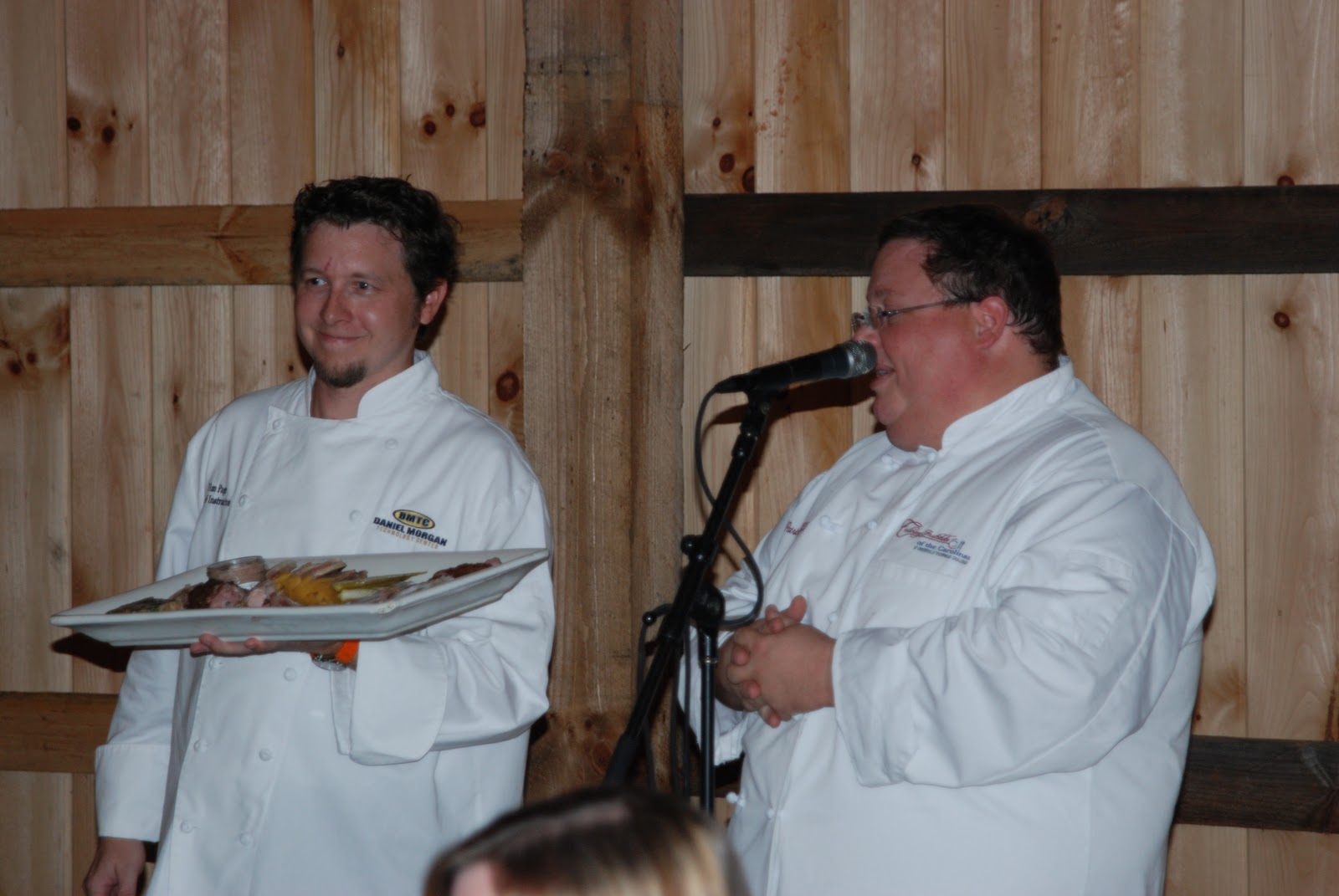
Honestly, when there are seven chefs involved in a dinner, each course is designed to showcase that chef's talent. It's like “Top Chef,” but in this case, it's a friendly non-competition to benefit a good cause. Still—each chef wants to make certain that his or her course is delicious. And memorable. Our talented chefs included:
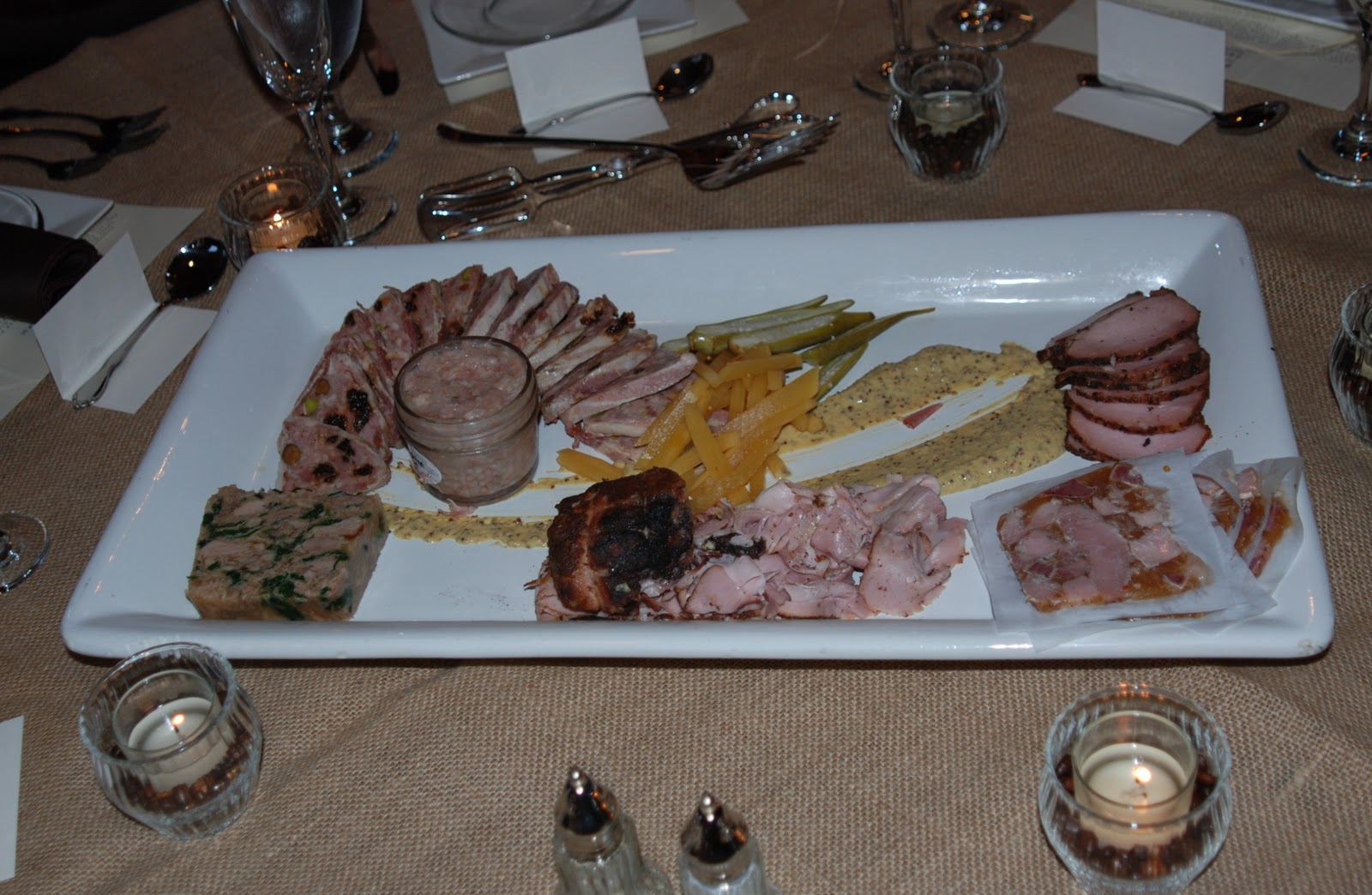
We began with the Charcuterie tray. Taken from the term cuiseur de chair, meaning "cooker of meat," charcuterie is a French culinary art dating to the 15th century. Originally a method to preserve food prior to the advent of refrigeration, it typically refers to pork specialties such as pâtés, rillettes, galantines, and crépinettes, which are made and sold in a delicatessen-style shop.
How does one make Crayfish Butter?
You know, I don't really care. The trout and butter were scrumptious.
This course won the showmanship award, with the broth poured at the table. The scent alone added about two inches to each of my thighs.
The ravioli? Mmmmm.
Delicious greens, courtesy our tablemate, Daniel, expertly prepared by Chef Stephanie Tornatore from City Range.
Crispy fried okra is my new favorite food.
Or maybe my new favorite food is corn and bacon succotash. Bacon added to anything is good, but the corn was amazingly fresh on its own. My dad, a former farm boy, was a corn connoisseur. I know good corn.
At this point, I had a hard time sitting upright in my chair—and it wasn't due to too much wine. I needed a walk. Or a nap.
And then this arrived...
Oh. My.
Anyone who knows me also knows that I never leave dessert. Dessert is my favorite course.
I couldn't conquer it. I ate half, wanting to lick the plate clean of the crème...and tried to figure out how I could sneak the rest of the cake home.
I apologize to the goats and the artisans who produced the cheese plate. It was lovely, but I already looked and felt about eight months pregnant by this point in the meal.
Besides trying to figure out how I could discreetly take my dessert home, I was also trying to determine how I could get Peter to carry me to the car.
Unfortunately, Peter made me waddle to car on my own.
When we left, the party was still going strong. Chefs mingled with diners. Exhausted volunteers finally relaxed and drank wine. Shoppers visited the Shaum's farm store for more food...
More food? Who could possibly shop for food after eating five courses???
...and Peter and I went home, where I happily put on my oversized PJs...
Note to self: never wear control-top tights to a multi-course farm dinner.
Ouch.
Oh. My.
I was wrong.
Take one noble organization: Hub City Farmers' Market. Add 14 local producers, seven prestigious chefs, a wine expert, a dozen volunteers, a lovely location with delightful hosts, and you have the recipe for a fabulous evening.
The first annual Farm Dinner organized by Hub City Farmers' Market is proof that commitment to a cause inspires excellence. Hub City Farmers' Market is a not-for-profit organization, unlike Outstanding in the Field. The proceeds from the dinner benefit the organization's community gardens and farmers' markets, as well as the Mobile Market, which takes local, healthy food to several locations in Spartanburg County. The mission of the Hub City Farmers' Market is to increase the demand and availability of healthy food in Spartanburg County.
The Market staff are terrific people. Dedicated. Creative. Eager to introduce local producers to the community and, in the case of the Farm Dinner, the community to the producers. Foodies unite with farmers, bakers with buyers. Executive Director Ana Parra leads the organization, and her talents are instrumental in the growth of the market and its programs. The amount of preparation and attention to detail required for the inaugural farm dinner is a full-time job.
Live Oak Farms in Woodruff, SC, provided the perfect venue for a farm-to-table dinner. The hosts, Allison and Chuck Shaum, are committed to sustainability. Not only do they specialize in pasture raised, heritage breed animals, but their farm is a prototype for solar generated energy. The farm store, which stocks organic products, locally produced meats, certified naturally grown produce, and South Carolina seafood, is powered entirely by solar energy. Solar panels charge the electric fences surrounding the fields. The Schaums don't just talk about the environment—they protect the resources that provide their livelihood.
Did I mention that they are genuinely nice people? Allison is the kind of person who remembers everyone's name, who takes the time to listen to the crazy ravings of a customer who fears preparing her first organic, free-range turkey for Thanksgiving. She's also the mother of four children, so she's good at managing her high-maintenance customers like me.
I wish she lived next door.
After dropping Kristen off in Duncan for a sleepover and taking Michael to Simpsonville to spend the night with my sister and niece, we actually arrived at Live Oak Farms on time. Shocking. It's amazing how Peter and I are motivated by food...
But we weren't alone. The Schaum's barn was crowded with locavores, eager to support the cause. Or, perhaps the attendees weren't as altruistic as I imagine. Maybe they just wanted to feast. And drink.
No matter what the diners' motivations, they wouldn't be disappointed.
The setting was actually more formal than the Outstanding in the Field dinner. I know you're thinking: barn = formal? Really? OK, skeptics, take a look at the lovely tables...with assigned seating.
Our tablemates were terrific—two producers (Frances Davis from Windmill Hills Farm and Daniel Parson from Parson's Produce) whose vegetables starred in several of the courses, as well as the publisher of Edible Upcountry and the new business manager of Converse Deli. I've known Daniel through Hub City Farmer's Market, and he's an incredible source of information about organic practices. Plus, he's just a really good guy who beams when he talks about his baby.
I hope he snuck some dessert home for his wife, who stayed home with baby Ben.
Samantha Wallace is the force behind the Upstate's newest publication, Edible Upcountry. If you haven't seen the magazine yet, you can find copies of the premier issue at many local retail sources, including Live Oak Farms. The Upstate needed this publication—a source that brings providers and customers together, much like farm dinners. Through the publication, though, you can find more detailed, personal information about the growers, producers, and people behind local foods. It's a terrific resource, and I'm not just saying it because of the article about my seed saving venture.
Really.
While the food is, of course, the enticement for the farm dinner, the best entertainment is to watch people coming together in an effort to support one another. For instance, Daniel and Samantha had not previously met. I'm not sure how that's possible, but the dinner provided an opportunity for them to meet and talk a bit of shop. The manager of Converse Deli was equally happy to meet Daniel. Converse Deli supports local food, to the extent that they recently invested in a 10-acre farm. Until the farm produces the amount of food they require for the restaurant, Daniel might be a source.
All of this synergy occurred just at our table. Who knows what relationships formed among the other guests?
Back to the food.
Oh. My.
Is it possible to have too much food?
I tried to pace myself, really, I did. But with five courses paired with delicious wines, plus amazing breads (my downfall), plus dessert...I think I'm still in a food coma three days later.
Honestly, when there are seven chefs involved in a dinner, each course is designed to showcase that chef's talent. It's like “Top Chef,” but in this case, it's a friendly non-competition to benefit a good cause. Still—each chef wants to make certain that his or her course is delicious. And memorable. Our talented chefs included:
Patrick Wagner, Culinary Institute of the Carolinas at Greenville Technical College
Tim Page, Daniel Morgan Technology Center
Gerhard Grommer, Gerhard's Cafe
Stephanie Tornatore, City Range
James P. McCalister, Milliken Guest House
Tray Mathis, Converse Deli
Anastasia Kaminski, R.D. Anderson Technology Center
Wine Pairings
Tony Forest, Carriage House Wine
Tim Page, Daniel Morgan Technology Center
Gerhard Grommer, Gerhard's Cafe
Stephanie Tornatore, City Range
James P. McCalister, Milliken Guest House
Tray Mathis, Converse Deli
Anastasia Kaminski, R.D. Anderson Technology Center
Wine Pairings
Tony Forest, Carriage House Wine
We began with the Charcuterie tray. Taken from the term cuiseur de chair, meaning "cooker of meat," charcuterie is a French culinary art dating to the 15th century. Originally a method to preserve food prior to the advent of refrigeration, it typically refers to pork specialties such as pâtés, rillettes, galantines, and crépinettes, which are made and sold in a delicatessen-style shop.
First Course: Charcuterie
Country Souse, Cajun Cured Pork Loins, Pork and Sweet Onion Rillets, Daube of Pork with Greens, Pastrami Cured Cottage Ham, Rustic Pate
Pickles/Condiments:
Boiled Peanut Relish, Garlic Pickled Okra, Bread and Butter Saffron Turnips.
Country Souse, Cajun Cured Pork Loins, Pork and Sweet Onion Rillets, Daube of Pork with Greens, Pastrami Cured Cottage Ham, Rustic Pate
Pickles/Condiments:
Boiled Peanut Relish, Garlic Pickled Okra, Bread and Butter Saffron Turnips.
Breads
Rosemary Sour Dough with Black Pepper and Live Oak Farms Asiago
Bee Well Honey and Wheat Sour Dough with Pecans
made by Tim Rogers
La Marca Prosecco
Rosemary Sour Dough with Black Pepper and Live Oak Farms Asiago
Bee Well Honey and Wheat Sour Dough with Pecans
made by Tim Rogers
La Marca Prosecco
Boiled peanut relish? Oh. My.
Who would have thought?
OK. Honestly, I could have stopped here. Between the meat and the bread, I was in heaven.
I'm so glad I didn't.
Second Course:
Smoked Carolina Sunburst Trout with a Crayfish Butter on Toasted Brioche served with a Matignon of Brunoise Garden Vegetables and a Lime Coriander Vinaigrette.
Artisan Pinot Noir
Smoked Carolina Sunburst Trout with a Crayfish Butter on Toasted Brioche served with a Matignon of Brunoise Garden Vegetables and a Lime Coriander Vinaigrette.
Artisan Pinot Noir
How does one make Crayfish Butter?
You know, I don't really care. The trout and butter were scrumptious.
Third Course:
Broth from Rabbit and Chicken Served with Rabbit Loins Wrapped in Pancetta
Ravioli with Rabbit Confit and Sliced Butternut and Wilted Mustard Greens.
Rockhouse Viognier
Broth from Rabbit and Chicken Served with Rabbit Loins Wrapped in Pancetta
Ravioli with Rabbit Confit and Sliced Butternut and Wilted Mustard Greens.
Rockhouse Viognier
This course won the showmanship award, with the broth poured at the table. The scent alone added about two inches to each of my thighs.
The ravioli? Mmmmm.
Fourth Course:
Crispy Okra Salad ~ Crispy Okra, Mizuna Greens, Turnips, Hericoverts, Cilantro, Carrots, Red Onion, Tossed with Honey Cumin Vinaigrette.
La Playa Cabernet Rose
Crispy Okra Salad ~ Crispy Okra, Mizuna Greens, Turnips, Hericoverts, Cilantro, Carrots, Red Onion, Tossed with Honey Cumin Vinaigrette.
La Playa Cabernet Rose
Delicious greens, courtesy our tablemate, Daniel, expertly prepared by Chef Stephanie Tornatore from City Range.
Crispy fried okra is my new favorite food.
Fifth Course:
Seared Manchester Farms Quail Breast with a Local Corn and Fresh Bacon Succotash Topped with a Fig Gastrique
Artisan Pinot Noir
Seared Manchester Farms Quail Breast with a Local Corn and Fresh Bacon Succotash Topped with a Fig Gastrique
Artisan Pinot Noir
Or maybe my new favorite food is corn and bacon succotash. Bacon added to anything is good, but the corn was amazingly fresh on its own. My dad, a former farm boy, was a corn connoisseur. I know good corn.
At this point, I had a hard time sitting upright in my chair—and it wasn't due to too much wine. I needed a walk. Or a nap.
And then this arrived...
Dessert
Apple Franzipan Crumb Cake with Wine Poached Apples, Cinnamon Calvados Crème Anglaise and Toasted Candy Pecans.
And the cheese plate...
Split Creek Goat Cheese and Apple Pecan Truffle, Blue Cheese with Caramelized Pear, Happy Cow Ricotta
JK Solstice Hard Cider
Oh. My.
Anyone who knows me also knows that I never leave dessert. Dessert is my favorite course.
I couldn't conquer it. I ate half, wanting to lick the plate clean of the crème...and tried to figure out how I could sneak the rest of the cake home.
I apologize to the goats and the artisans who produced the cheese plate. It was lovely, but I already looked and felt about eight months pregnant by this point in the meal.
Besides trying to figure out how I could discreetly take my dessert home, I was also trying to determine how I could get Peter to carry me to the car.
Unfortunately, Peter made me waddle to car on my own.
When we left, the party was still going strong. Chefs mingled with diners. Exhausted volunteers finally relaxed and drank wine. Shoppers visited the Shaum's farm store for more food...
More food? Who could possibly shop for food after eating five courses???
...and Peter and I went home, where I happily put on my oversized PJs...
Note to self: never wear control-top tights to a multi-course farm dinner.
Ouch.
Oh. My.
Subscribe to:
Posts (Atom)